Chapter 1 · The Lab
Thermodynamics & Heat Control
Concept Definition Cooking is simply the management of energy transfer. We apply heat to ingredients to denature proteins (texture) and trigger chemical reactions (flavor). Most home cooks view heat as a single dial: “Hot.” A professional views heat as a spectrum of Transfer Methods. Understanding how energy moves allows you to choose the right tool: a heavy cast iron for conduction or a convection oven for air circulation.
The Physics: The Three Engines Heat moves in three specific ways. You must know which one you are using.
- Conduction (Contact): Heat moves from a solid to a solid.
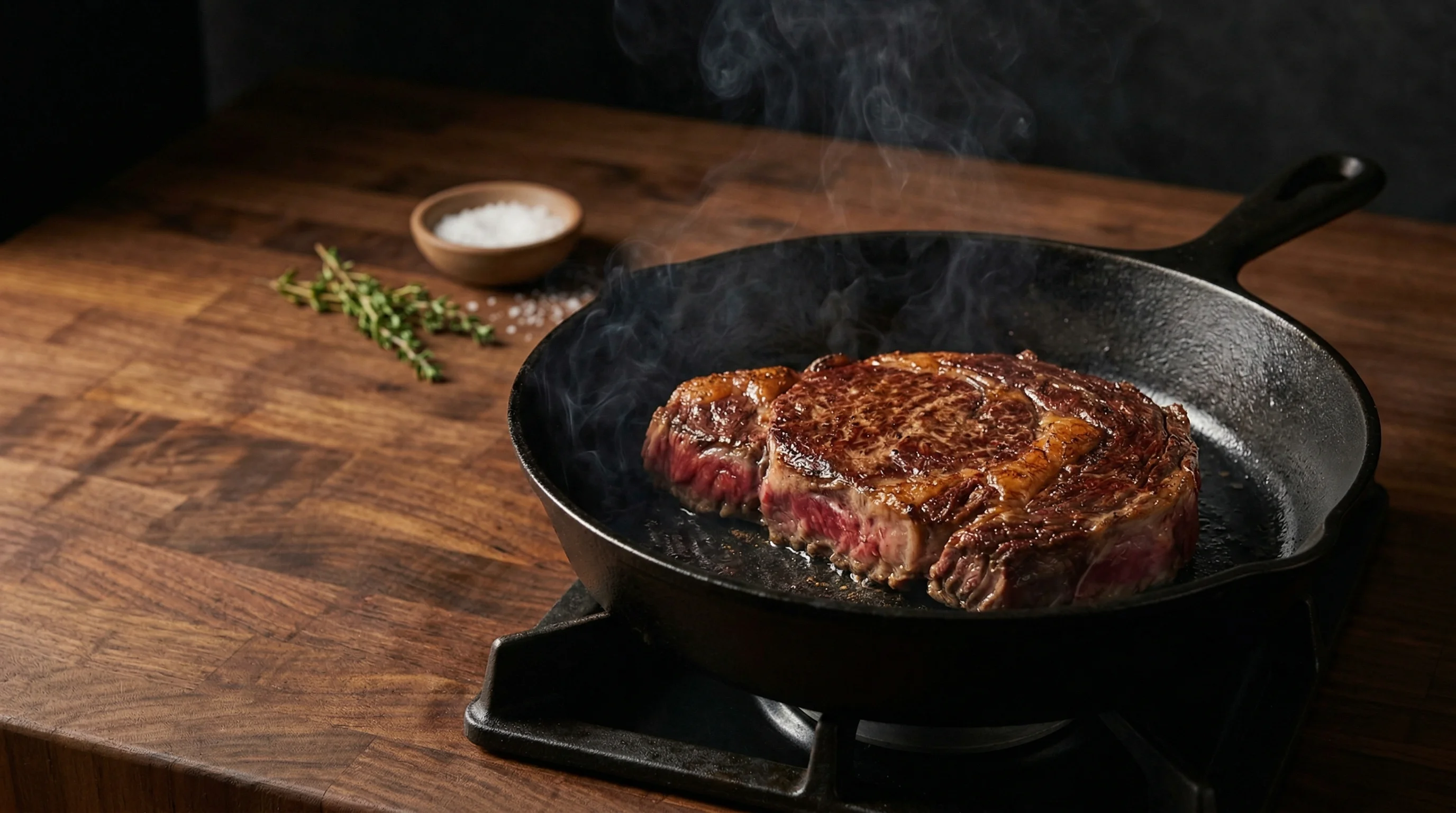
- Example: A steak hitting a cast iron pan.
- The Rule: Surface area equals flavor. Flat contact creates the Maillard reaction.
- Convection (Circulation): Heat moves through a fluid (air, water, oil).
- Example: Boiling pasta, deep frying, or a convection oven.
- The Rule: Movement equals speed. A convection fan blows away the cold air “insulation” surrounding food, cooking it 25% faster.
- Radiation (Waves): Heat travels through space as electromagnetic waves.
- Example: Broiling, grilling over charcoal, or a toaster.
- The Rule: Proximity equals intensity. Moving a tray 2 inches closer to the broiler doubles the heat intensity (Inverse Square Law).
The Chemistry: The Maillard Reaction This is the “Holy Grail” of savory flavor—the browning of meat and crusts.
- The Threshold: It only begins effectively at 300°F/150°C.
- The Enemy: Water boils at 212°F/100°C.
- Implication: If your pan is crowded, moisture gets trapped. The temperature caps at 212°F, and you steam your steak gray instead of searing it brown.
- The Fix: Dry your meat thoroughly with paper towels before searing.
The Variable: Atmospheric Pressure (Elevation) Water does not always boil at 212°F/100°C. It boils when its internal vapor pressure equals the air pressure around it.
- Sea Level: Water boils at 212°F.
- High Altitude (Denver, 5,000ft): Less air pressure means water boils easier, at ≈203°F/95°C.
- The Impact: Since your boiling water is colder, beans and pasta take longer to cook. You are cooking with “weak” heat. You must increase cook times by 10–15% or use a pressure cooker to artificially raise the boiling point.
Practical Application: The Leidenfrost Effect How do you make a stainless steel pan non-stick without Teflon? Physics.
- The Concept: If a pan is hot enough (≈380°F/193°C), a drop of water will instantly vaporize, creating a cushion of steam that the water floats on.
- The Technique: Heat your stainless pan dry. Add a drop of water.
- Too Cold: It sizzles and evaporates.
- Ready: It forms a mercury-like ball and skitters across the surface without evaporating.
- Action: Wipe out the water, add your oil, and immediately add the food. The food now rides on that oil/steam layer, preventing sticking.
Chef’s Note: Oven vs. Stovetop Heat
- Stovetop: Aggressive, directional heat (from the bottom). Used for Searing (texture).
- Oven: Ambient, surrounding heat. Used for Roasting (internal doneness).
- The Hybrid Method: Start thick proteins (steaks, chops) on the stove to brown (Conduction), then move the pan to the oven to finish (Convection). This gives you the crust of a sear with the even doneness of a roast.
Practice Exercise: The “Toast” Map Goal: Identify the hot spots in your oven.
- Setup: Preheat oven to 350°F/175°C.
- Action: Cover a baking sheet entirely with slices of cheap white bread. Bake for 10–15 minutes.
- Result: Look at the browning pattern.
- Observation: You will likely see dark toast in the back corners and pale bread near the door.
- Correction: This map tells you why you must rotate your trays halfway through baking.
Glossary
- Maillard Reaction: A chemical reaction between amino acids and reducing sugars that produces browned flavor in food.
- Convection: A heat transfer method involving the movement of fluids (air or liquid) to distribute heat.
- Radiation: A heat transfer method involving electromagnetic waves, such as infrared radiation.
- Leidenfrost Effect: A phenomenon where a liquid droplet suspended above a hot surface vaporizes due to the intense heat, creating a cushion that prevents direct contact.
- Searing: A high-heat cooking technique using direct contact with a hot surface to develop a browned crust on food.
- Threshold: The minimum temperature required for a specific chemical reaction, such as the Maillard reaction, to occur effectively.
- Inverse Square Law: A principle stating that the intensity of radiation decreases proportionally to the square of the distance from the source.