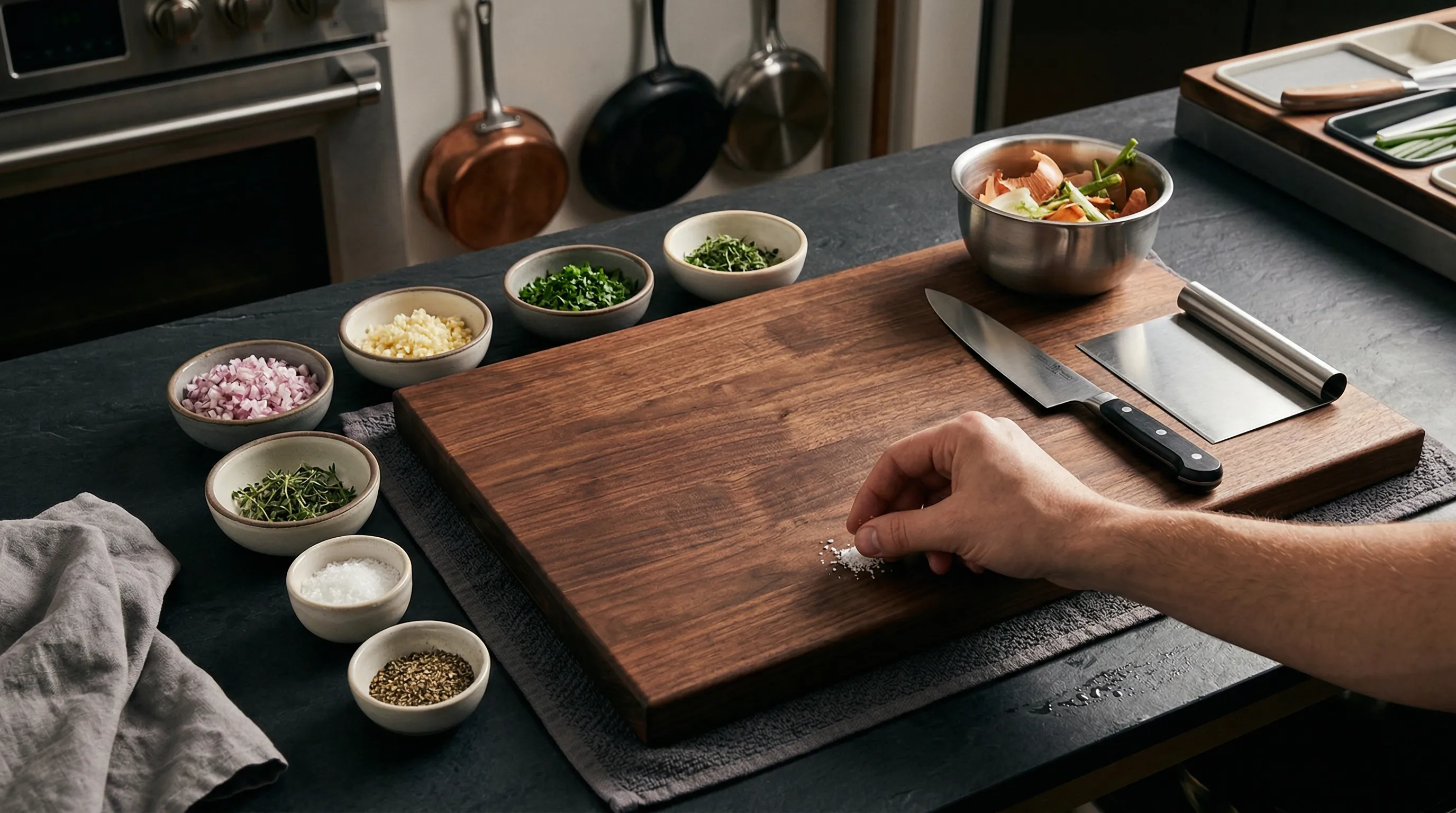
Chapter 2 · The Foundation
The Kitchen Cockpit (Station Management)
Concept Definition: In a professional kitchen, your cutting board is not just a surface; it is your cockpit. “Mise en place” is often mistranslated as simply “ingredients prep,” but its literal meaning is “putting in place.” It is a philosophy of environmental control. Before you cook, you must build a system that reduces physical movement and cognitive load. If you have to walk across the kitchen to find the salt, your station is broken.
The Science: Cognitive Load & Thermodynamics
- Cognitive Load: Cooking requires split-second timing. By arranging tools and ingredients in a standardized layout, you remove the “search” function from your brain. This preserves mental energy for thermal execution (managing heat).
- Sanitation Vectoring: Bacteria (Salmonella, E. coli) move via cross-contamination. A managed station separates “Raw Protein,” “Ready-to-Eat (Veg),” and “Waste” into distinct physical zones, preventing pathogens from migrating to your finished dish.
- Thermodynamics: A disorganized station leads to delays. Delays lead to temperature loss. A tight station ensures ingredients hit the pan at the precise moment required to maintain the Maillard reaction or emulsion stability.
Practical Application To build your Cockpit, you must establish three non-negotiable zones before picking up a knife.
- The Anchor (Safety): A cutting board must never slide. Place a damp paper towel or a non-slip mat explicitly under your board. If the board moves, you will eventually cut yourself.
- The Zones (Workflow):
- Zone 1: The Active Zone. The center of the board. Only the item currently being cut exists here.
- Zone 2: The Reserve (Left). Whole vegetables or proteins waiting to be processed.
- Zone 3: The Finished (Right). A dedicated vessel (bowl or tray) for processed food. Never pile cut food on the board; it clutters your workspace and endangers your knife edge.
- Zone 4: The Waste (Top Right/1 o’clock). A “garbage bowl” for peels and scraps. Do not walk to the trash can between cuts.
- The Tool Deck: Your knife, bench scraper, and towel belong on the right (for right-handers). They must always be returned to the same spot so your hand can find them without looking.
Practice Exercise: The “Blind Reach” Test Goal: Verify your station ergonomics.
- Set Up: Place your cutting board, knife, waste bowl, and finished prep bowl in your “Cockpit” configuration.
- The Test: Close your eyes. Reach for your knife handle. Reach for the waste bowl.
- Evaluation: If you knocked anything over or fumbled, your layout is inefficient. Adjust until you can locate every zone by proprioception (muscle memory) alone.
Part II: Sanitation Protocols (The “Red Board” Rule)
Concept Definition: In professional kitchens, we use a universal color-coding system to eliminate the risk of cross-contamination.
- Red: Raw Red Meat
- Yellow: Raw Poultry
- Green: Vegetables/Fruit
- White: Dairy/Bakery
- Blue: Raw Seafood
- Brown: Cooked Meat
At home, you likely do not have six different boards. Therefore, you must replace separation by space with separation by time (Sequencing).
The Science: Bacterial Vectoring Cross-contamination is not just about the board; it is about “vectors”—the vehicles that move pathogens (Salmonella, Campylobacter, E. coli) from one surface to another.
- The Primary Vector: Your hands. If you touch raw chicken, then grab your salt cellar, the salt cellar is now contaminated.
- The Secondary Vector: The knife handle. Washing the blade but forgetting the handle is a common cause of illness.
- The “Invisible” Film: Bacterial biofilms can adhere to the micro-grooves in a plastic board. Unlike wood, which has natural antimicrobial properties (tannins) that can trap and kill bacteria, deeply scarred plastic boards can harbor colonies that standard sponging won’t remove.
Practical Application: The Home Sequencing Rule If you only have one cutting board, you must follow the Strict Hierarchy of Prep. This is non-negotiable.
- Group 1: “Ready-to-Eat” (RTE). Start here. Herbs, garnishes, lemons, bread. Anything that will not be cooked further. If these touch a contaminated board, the bacteria will go straight into the diner’s mouth.
- Group 2: “Vegetables to be Cooked.” Onions, carrots, celery. These will be heated, which offers a safety buffer, but they should still be clean.
- Group 3: “The Hazard.” Raw proteins. Always cut these last.
- The “Board Flip”: If you have a reversible board, do all veg on Side A, flip, and do meat on Side B.
- The “Sheet Trick”: If you don’t want to sanitize your heavy wooden block mid-prep, place a flexible plastic sheet or even a sheet of parchment paper over the wood to cut the meat, then discard.
The “One Hand” Technique To keep your station clean while handling meat:
- The Wet Hand: Your non-dominant hand touches the raw meat. It never leaves the meat zone.
- The Dry Hand: Your dominant hand holds the knife. It never touches the meat directly.
- This ensures your knife handle—and thus your salt cellar, oven door, and towels—remains sanitary.
Glossary
- Cognitive Load: The deliberate organization of a workstation minimizes the mental effort required for task execution by reducing the need for constant searching and retrieval.
- Sanitation Vectoring: Employing spatial segregation—distinct zones for raw, cooked, and contaminated materials—effectively disrupts bacterial transmission pathways.
- Biofilm: A complex, structured microbial community that adheres to surfaces, often presenting a significant challenge to conventional sanitation methods due to its resistance to disruption.
- Maillard Reaction: A non-enzymatic browning reaction between reducing sugars and amino acids, contributing significantly to flavor and aroma development during cooking.
- Proprioception: The body’s ability to sense its position and movement in space, crucial for efficient and instinctive task execution, particularly in a practiced environment.
- Strict Hierarchy of Prep: A sequential workflow prioritizing the preparation of foods with the highest risk of bacterial contamination, minimizing the potential for cross-contamination. The adherence of microorganisms to surfaces, forming a protective matrix that resists disruption by standard cleaning agents.
- Tannins: Polyphenolic compounds found in wood, possessing inherent antimicrobial properties that can inhibit bacterial growth through various mechanisms.