Chapter 3 · Garde Manger
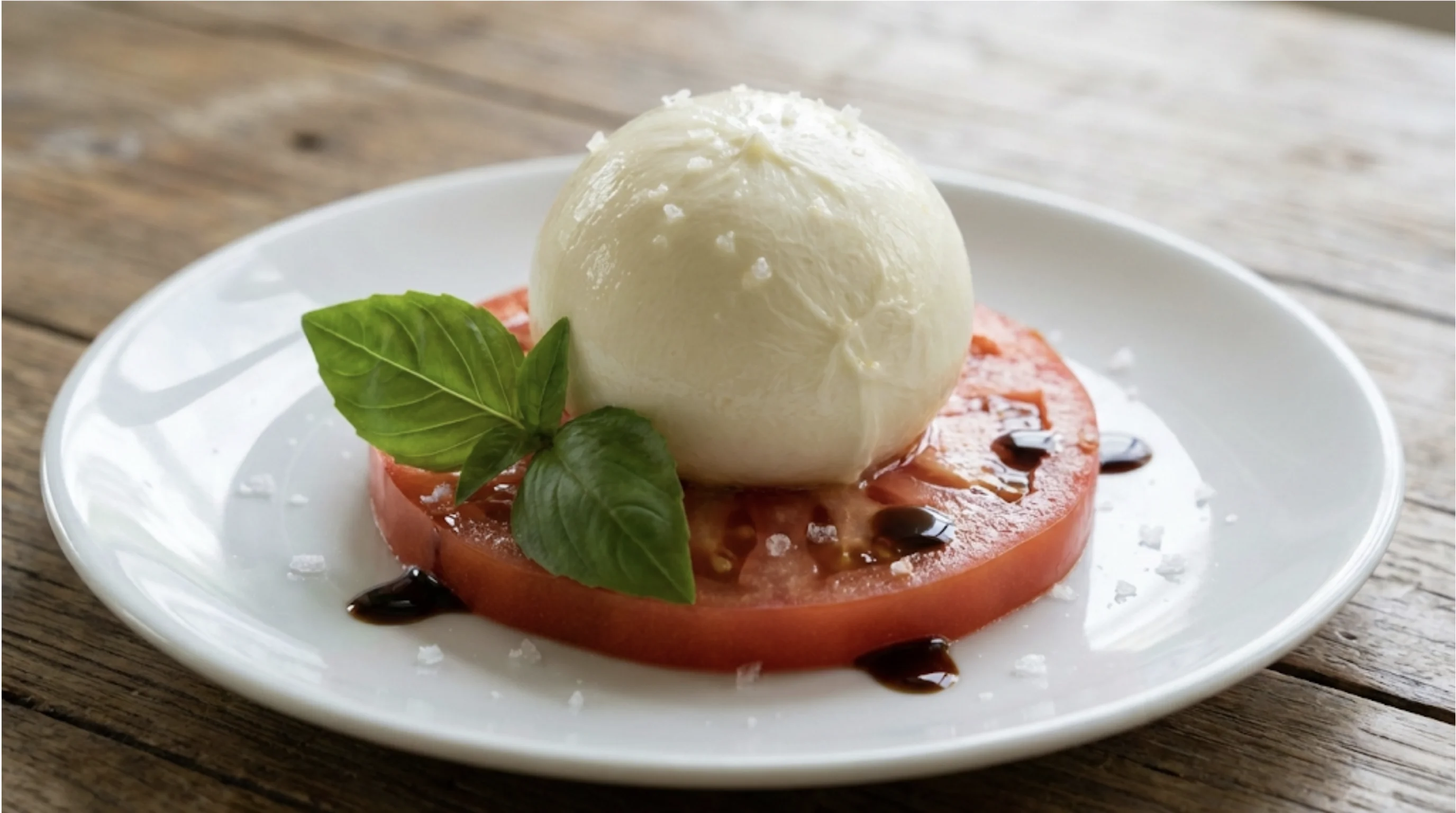
Caprese 'Ravioli' (Liquid Mozzarella Spheres)
A modernist antipasto featuring a liquid mozzarella core that bursts when eaten.
Yield: 12 spheres | Prep: 40 min | Inactive: 12 hr (Bath) | Cook: 5 min | Total: ~13 hr
Headnote
This dish deconstructs the classic insalata caprese into a textural surprise. Instead of a slice of cheese, we serve a delicate membrane of mozzarella cream that releases its liquid contents instantly upon biting. Teaching Idea: Viscosity Matching. The mozzarella base must be thick enough to hold a spherical shape as it falls into the bath, but liquid enough to flow when the membrane is pierced.
Ingredients
The Alginate Bath
- 1000 ml (4 cups) distilled water (low calcium)
- 5 g (1 tsp) Sodium Alginate
The Mozzarella Base
- 250 g (9 oz) fresh buffalo mozzarella (with brine)
- 60 ml (¼ cup) heavy cream
- 60 ml (¼ cup) mozzarella brine (or milk)
- 5 g (1 tsp) Calcium Lactate Gluconate (CLG)
- Salt to taste
Assembly
- 2 large heirloom tomatoes, sliced thick
- Fresh basil leaves (or basil oil)
- Aged balsamic vinegar
- Flaky sea salt (Maldon)
Mise en Place (Action Checklist)
- Hydrate the alginate bath (requires 12 hours/overnight rest to degas).
- Blend the mozzarella base and strain it fine.
- Dice the tomatoes for the bed (concasse or slab).
- Prepare a holding bowl with cold water for rinsing.
Method
Phase 1: Prepare the Alginate Bath
Blend the water and sodium alginate using an immersion blender until fully dissolved. Strain and refrigerate for 12 hours.
Why: Blending introduces air bubbles that will mar the surface of your spheres. The rest period allows the air to escape and the liquid to become crystal clear.
Phase 2: Construct the Base
Tear the mozzarella into chunks. Place in a high-speed blender with the cream, brine, and Calcium Lactate Gluconate. Blend until completely smooth. Taste and season with salt.
Texture Check: The mixture should have the consistency of thick pancake batter. If too thick, thin with milk; if too thin, it will flatten in the bath.
Phase 3: Spherify (The Drop)
Pour the alginate bath into a flat-bottomed dish (at least 5 cm deep). Fill a hemispherical tablespoon with the mozzarella mixture. Bring it close to the surface of the bath and pour it in a swift, fluid motion. Repeat for as many spheres as fit without touching.
Phase 4: Cook the Membrane
Allow the spheres to float for 2 minutes. Gently agitate the water to ensure they don’t stick to the bottom.
Why: The calcium in the cheese is reacting with the alginate in the water to form the skin. Leaving it longer makes the skin thick and rubbery; pulling it too soon makes it fragile.
Phase 5: Rinse and Hold
Using a slotted spoon, carefully lift the spheres and transfer them to the cold water bowl to stop the gelling process and rinse off the bitter alginate.
Note: These are best served within 30 minutes. Storing them in plain water will eventually dilute the flavor through osmosis.
Phase 6: Plating
Place a thick slice of tomato on the plate. Gently rest one mozzarella sphere on top. Garnish with a leaf of basil, a drop of balsamic, and flaky salt.
Technique Required: Reverse Spherification. See Chapter 1.
Glossary
- Viscosity: The measure of a fluid’s resistance to flow (thickness).
- Sodium Alginate: A polysaccharide derived from brown algae used to create a gel-forming bath for spherification techniques.
- Calcium Lactate Gluconate (CLG): A calcium salt used in reverse spherification because it has a neutral taste and high solubility, unlike Calcium Chloride which can be bitter.
- Reverse Spherification: A culinary technique utilizing sodium alginate to create a gel membrane around a liquid center, contrasting with traditional spherification.
- Concasse: A technique for preparing tomatoes: peeling, seeding, and dicing them.
- Osmosis: The movement of solvent molecules through a semipermeable membrane from a region of high water concentration to a region of low water concentration.
- Emulsification: The process of combining two immiscible liquids, such as oil and water, into a stable mixture, often aided by an emulsifier.