Chapter 6 · The Poulterer
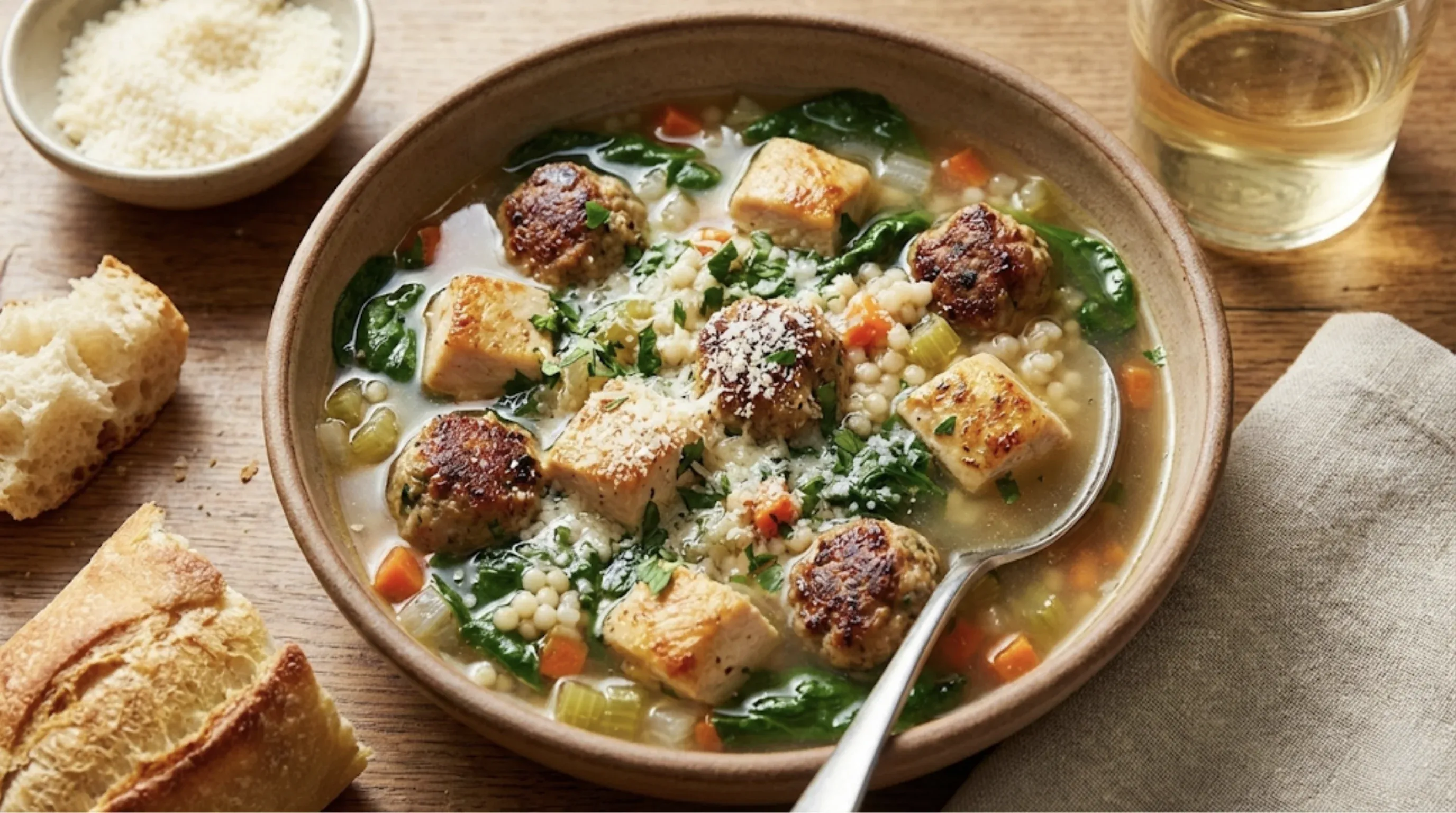
Italian Wedding Soup (Pollo Rustica)
A robust dual-protein soup featuring toasted Israeli couscous, seared chicken, and tender Boursin meatballs.
Yield: 4–6 servings | Prep: 30 min | Cook: 45 min | Total: ~75 min
Headnote
This “Rustica” variant moves away from delicate starters into main-course territory. We replace standard orzo with Israeli couscous, treating it like risotto to preserve texture. The “marriage” here is threefold: the savory depth of the roasted meatballs, the Maillard-rich seared chicken, and the bright, vegetal finish of fresh herbs.
Ingredients
The Proteins
- 1 batch Mini Boursin & Bacon Meatballs (scaled to 38 g; see Chapter 3)
- 2 large chicken breasts, cubed
- 30 ml (2 tbsp) olive oil (for searing)
The Soup Base
- 1 yellow onion, small dice
- 2 carrots, small dice
- 2 celery stalks, small dice
- 3 cloves garlic, minced
- 240 g (1½ cups) Israeli couscous (Pearl couscous)
- 1.5 L (6 cups) chicken stock (high quality)
- 120 ml (½ cup) dry white wine (Pinot Grigio or Sauvignon Blanc)
- Diamond Crystal kosher salt and freshly cracked black pepper, to taste
The Finish
- 150 g (5 oz) fresh spinach
- 15 g (2 tbsp) fresh flat-leaf parsley, finely chopped
- Freshly grated Parmesan cheese
Mise en Place (Action Checklist)
- Have ready: 1 batch Mini Boursin & Bacon Meatballs (see Chapter 3), roasted and warm.
- Process the Chicken: Cut chicken breasts into 1-inch (2.5 cm) cubes. Pat dry with paper towels (crucial for searing).
- Dice the Mirepoix: Small dice the onion, carrots, and celery (aim for sizes matching the couscous pearls).
- Prepare Aromatics: Mince the garlic cloves and finely chop the parsley.
- Measure the Couscous: Have the Israeli couscous ready.
Method
1. Sear the Chicken (The Maillard Step) Heat olive oil in a cast-iron skillet over high heat until shimmering. Add chicken cubes in a single layer (do not crowd). Sear hard for 2–3 minutes until golden brown on one side.
- Note: The chicken should still be raw in the center.
- Why: We want the flavor of the crust, but we will finish cooking it gently in the broth later to keep it tender. Remove chicken and set aside.
2. Deglaze and Build the Base In a large Dutch oven or soup pot, add a splash of oil and the mirepoix (onion, carrot, celery). Sauté over medium heat until onions are translucent (5–6 min). Add the minced garlic and cook for 45 seconds until fragrant. Pour the white wine into the hot cast-iron skillet used for the chicken. Scrape up the fond (browned bits). Pour this flavorful liquid into the soup pot with the vegetables.
3. Toast the Starch Add the dry Israeli couscous to the soup pot. Stir constantly for 2–3 minutes.
- Sensory Cue: The pearls should smell nutty and turn a light golden brown.
- Why: This toasts the outer starch layer, preventing the pasta from releasing too much amylose and turning the soup cloudy/gummy.
4. Simmer the Broth Add the chicken stock to the pot. Bring to a boil, then reduce to a simmer. Cook for 8–10 minutes, or until the couscous is al dente (firm to the bite).
5. The Marriage (Final Assembly) Reduce heat to low. Add the seared chicken cubes and the roasted meatballs to the pot. Simmer gently for 3–5 minutes.
- Check: Ensure chicken is cooked through and meatballs are hot.
- Finish: Turn off the heat. Stir in the fresh spinach and chopped parsley immediately. They will wilt in seconds. Taste and adjust salt/pepper. Serve with Parmesan.
Glossary
- Maillard Reaction: A chemical reaction between amino acids and reducing sugars that produces browned food with complex flavor.
- Fond: The concentrated, browned flavor residue (gelatin) left on the bottom of a pan after searing or sautéing.
- Mirepoix: A foundational flavor base consisting of diced onions, carrots, and celery, commonly used in French and Italian cuisine.
- Deglaze: The process of dissolving the fond (browned bits) from a pan by adding a liquid, typically wine or stock.
- Al Dente: A term describing pasta or grains that are cooked to be firm to the bite, retaining a slight resistance.