Chapter 6 · The Poulterer
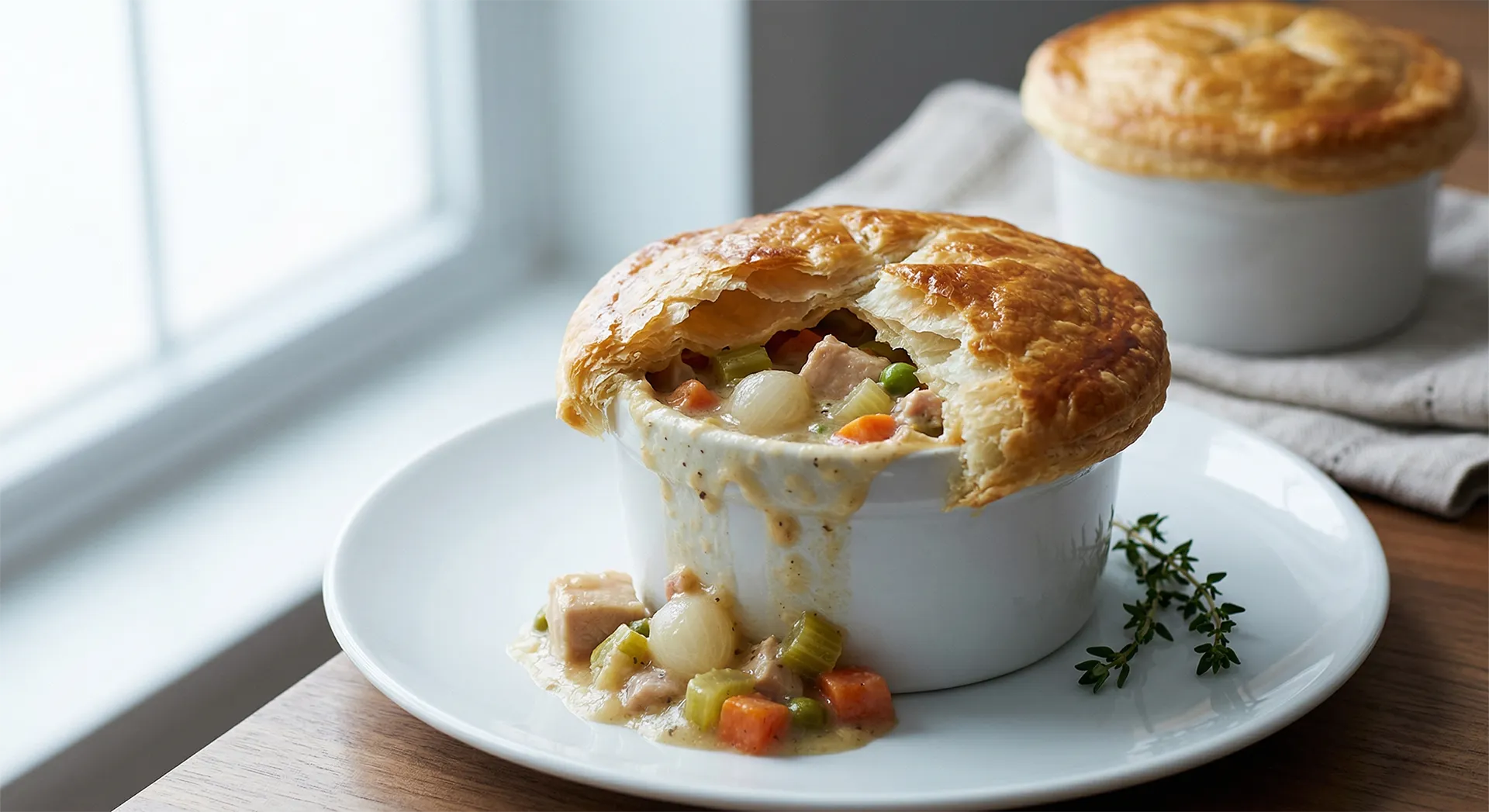
Modern Chicken Pot Pie (Velouté Method)
A classic comfort dish elevated through a precise blonde roux velouté and a hydrated, leavened crust.
Yield: 4 servings | Prep: 20 min | Cook: 45 min | Total: ~65 min
Headnote
The soul of a pot pie lies in its binder. By utilizing a velouté — one of the five French mother sauces, made from a light stock and a roux — we achieve a silky mouthfeel without the heaviness of heavy cream. The leavened topping is a quick, cake-like batter that bakes into a tender biscuit cap, but the recipe also accepts a traditional shortcrust without modification. Teaching Idea: Starch Gelatinization. We cook the roux for five minutes to remove the raw flour taste while ensuring the starch granules are intact and primed to swell once the broth is added — this is the moment that determines whether the binder is silky or pasty.
Ingredients
The Velouté Base
- 28 g (2 tbsp) unsalted butter
- 16 g (2 tbsp) all-purpose flour
- 480 g (2 cups) chicken broth (see 10-01 Fond Blanc)
- 2 g (½ tsp) Diamond Crystal kosher salt
- 1 g (¼ tsp) cracked black pepper
The Inclusion Mix
- 150 g (1 cup) cooked chicken, diced
- 283 g (10 oz) frozen mixed vegetables, thawed and patted dry
- 100 g (1 small) potato, cooked and diced
The Leavened Crust
- 125 g (1 cup) all-purpose flour
- 6 g (1½ tsp) baking powder
- 2 g (½ tsp) Diamond Crystal kosher salt
- 120 g (½ cup) whole milk
- 50 g (1 large) egg
Mise en Place (Action Checklist)
- Dice the cooked chicken and cooked potato into uniform 1 cm (½-inch) cubes.
- Thaw the frozen vegetables and pat them dry to avoid diluting the velouté.
- Whisk the egg and milk together until fully emulsified.
- Preheat the oven to 400°F/205°C.
- Temper the fillings: Allow the chicken and vegetables to come to room temperature so the velouté heats evenly.
- Pastry note: If using commercial pie crust instead of the leavened topping, keep it refrigerated until the moment of assembly.
Method
Phase 1: The Roux and Velouté. In a medium saucepan, melt the butter over medium heat. Add the flour and whisk constantly for 5 minutes. Sensory cue: the mixture should smell slightly nutty and look like pale wet sand — it should not turn brown. Why: this “blonde roux” cooks out the raw cereal flavor while preserving maximum thickening power. Slowly stream in the chicken broth while whisking vigorously to prevent lumps. Bring to a boil, then immediately reduce to a simmer.
Phase 2: The Filling Assembly. Fold in the diced chicken, potatoes, and thawed vegetables. Season with salt and pepper. Continue to simmer until the inclusions are warmed through and the sauce coats the back of a spoon (nappé). Pour the mixture into a 2-quart (1.9 L) casserole dish.
Phase 3: The Topping and Hydration. In a separate bowl, combine the flour, baking powder, and salt. Add the milk and egg, stirring just until combined. Do not overmix — overworking develops gluten, which makes the topping tough rather than cake-like. Pour the batter evenly over the chicken mixture, allowing it to spread on its own.
Phase 4: The Bake. Place the dish in the center of the oven. Bake at 400°F/205°C for 30 minutes. Sensory cue: the top should be deep golden brown and firm to the touch, with the velouté visibly bubbling at the edges. Rest for 5 minutes before serving to allow the sauce to set.
Variations
- Protein Substitution. This method works perfectly with leftover turkey or poached salmon. Reduce bake time by 5 minutes for seafood.
- Commercial Pastry Adaptation. To swap the leavened topping for a store-bought refrigerated pie crust: omit the flour, baking powder, milk, and egg from the topping list. Roll the chilled crust over the filled casserole, trim the overhang to 1 inch, fold under, and crimp to the rim. Cut 3–4 steam vents in the center — without these, steam from the boiling velouté will balloon the crust and separate it from the filling, leading to a soggy interior. Brush with egg wash (1 egg beaten with 15 g water) to encourage Maillard browning.
Chef’s Notes
- The Umami Boost. Whisk 5 g (1 tsp) of white miso into the broth during Phase 1 for a deeper savory profile without changing the dish’s character.
Glossary
- Velouté: A savory sauce made from a roux and a light stock (chicken, fish, or veal); one of the five French mother sauces.
- Roux: A cooked mixture of equal parts by weight of fat and flour, used to thicken sauces.
- Blonde Roux: A roux cooked just long enough to lose the raw flour taste but not long enough to take on color, preserving maximum thickening power.
- Nappé: The consistency of a sauce thick enough to evenly coat the back of a spoon.
- Gelatinization: The process by which starch granules absorb liquid and swell when heated, creating viscosity.