Chapter 6 · The Poulterer
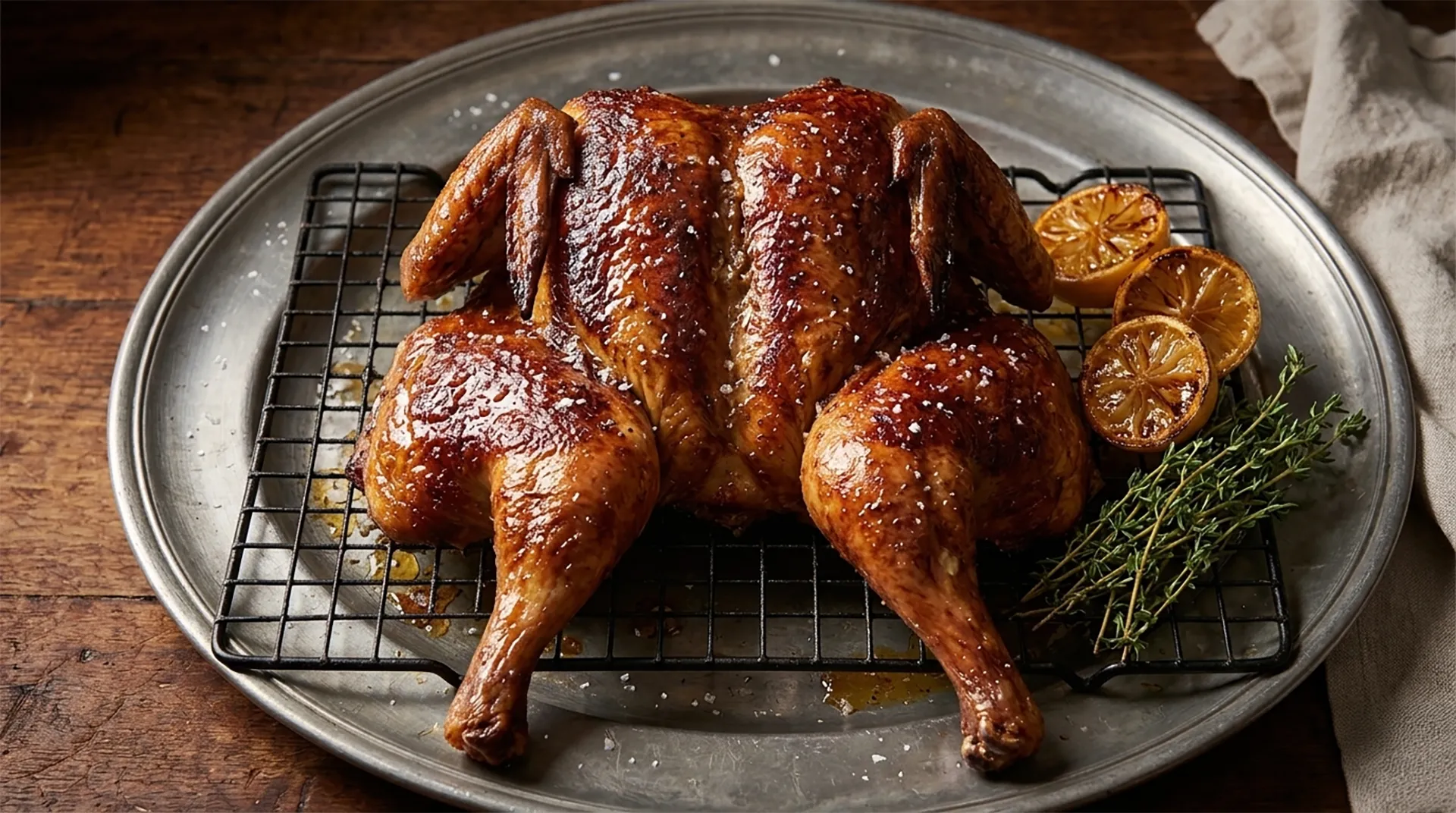
Whole Roast Chicken (Spatchcock, Dry-Brine)
Yield: 4 servings | Prep: 30 min | Inactive: 24–48 hr | Cook: 40–70 min | Total: 25–49 hr
Headnote
This folio is the centrepiece of Chapter 6 — a whole bird taken apart and put back together with intention. Spatchcocking removes the backbone and flattens the bird, solving one of the oldest problems in roasting: the breast finishes 15–20°F too early relative to the thigh, drying out before the dark meat reaches a safe temperature. By equalizing the geometry, we bring both zones to temperature simultaneously. Dry-brining — salt applied directly to the surface and left uncovered in refrigerator air — draws moisture out by osmosis, then pulls it back in as the salt dissolves and diffuses into the muscle. After 24–48 hours, the result is deeper seasoning at depth and a dramatically drier skin surface, the prerequisite for the Maillard reaction to proceed at roasting temperature. The compound butter — thyme, garlic, and lemon zest worked into softened butter — is applied under the skin directly against the breast meat, which protects the muscle from direct convective heat, bastes continuously as the fat renders, and carries aromatics into the flesh rather than over it.
Teaching Idea: Dry-Brine Osmosis. Salt on the raw surface initially draws cellular moisture outward (visible as beading after the first hour). As the salt dissolves in that liquid, the resulting brine is reabsorbed back into the muscle via diffusion. The protein structure relaxes under this salinity gradient, retaining more moisture during cooking and seasoning the meat from within rather than only at the surface.
Ingredients
The Bird
- 1 whole chicken, 3½–5½ lb (1.6–2.5 kg), spine removed and spatchcocked (instructions in Mise en Place below)
- 9 g (1½ tsp) Diamond Crystal kosher salt, for dry-brine
The Compound Butter
- 57 g (4 tbsp) unsalted butter, room temperature
- 2 medium garlic cloves, finely grated (approximately 6 g)
- 4 g (1½ tsp) fresh thyme leaves, stripped from stems
- 1 lemon, zest only (approximately 3 g)
- 1 g (¼ tsp) Diamond Crystal kosher salt
- 1 g (¼ tsp) freshly ground black pepper
For Roasting
- 15 ml (1 tbsp) neutral oil (grapeseed or avocado)
- Flaky sea salt, for finishing (optional)
- Aluminum foil, for resting
- 1 wire rack + 1 rimmed sheet pan
Mise en Place
Note: This recipe uses the spatchcock method. If you are roasting the bird whole, the method changes significantly — see Whole-Bird Variant in Chef’s Notes before proceeding.
- Remove the chicken from packaging. Pat completely dry with paper towels.
- To spatchcock: Place the chicken breast-side down on a stable cutting board. Using heavy kitchen shears, cut along both sides of the backbone from tail to neck and remove it entirely. Flip the bird breast-side up. Place the heel of your palm at the centre of the breastbone and press firmly until you hear the cartilage crack and the bird lies flat.
- Season the surface with 9 g Diamond Crystal kosher salt — distribute evenly over both sides, including the underside and the skin.
- Place the salted bird on a wire rack set inside a rimmed sheet pan, skin-side up and uncovered. Refrigerate for 24–48 hours.
- When ready to roast, remove the chicken from the refrigerator and allow it to sit at room temperature for 30–45 minutes.
- Preheat the oven to 425°F/220°C with a rack in the upper-middle position.
- Make the compound butter: Combine the room-temperature butter, grated garlic, thyme, lemon zest, salt, and pepper in a small bowl. Work together with a spatula or fork until fully integrated. The mixture should be cohesive and spreadable, not broken.
Method
Phase 1 — Apply the Compound Butter
-
Place the tempered chicken breast-side up on the wire rack. Gently slide your fingers under the breast skin, working from the neck cavity toward the thigh, to create a pocket between the skin and the meat. Take care not to tear the skin.
-
Spoon approximately two-thirds of the compound butter under the skin, directly against the breast meat. Use your fingers to spread it as evenly as possible from outside the skin, pressing into the corners of the pocket.
-
Spread the remaining compound butter over the exterior skin of the breast and thighs.
-
Rub lightly with the neutral oil. The oil encourages even browning where the butter alone would pool. The skin surface should appear uniformly coated, not patchy.
Phase 2 — Roast
-
Transfer the sheet pan to the preheated oven, breast-side up. Roast at 425°F/220°C without opening the oven door. Begin temperature checks at 40 minutes for smaller birds (3½ lb/1.6 kg); expect 60–70 minutes for larger birds (5–5½ lb/2.3–2.5 kg). The breast skin should be a deep mahogany — not pale gold, not scorched at the edges.
-
Test doneness with an instant-read thermometer. Insert at the thickest point of the thigh, angled away from the bone: target 165°F/74°C. Check the breast separately at the deepest point of the pectoral muscle: target 155–160°F/68–71°C. The breast will carry-over to a safe temperature during rest.
Why: The USDA safe temperature for poultry is 165°F/74°C at the thigh. The breast, being a leaner muscle, will reach this through carry-over if pulled at 155–160°F/68–71°C — preserving moisture. Pulling the breast at 165°F/74°C invariably produces dry meat.
Phase 3 — Rest
-
Transfer the chicken to a carving board and tent loosely with aluminum foil. Rest for 10–12 minutes. Do not cut immediately — the juices are still in motion and will run out of the muscle if carved before equilibration.
Sensory Cue: The skin will soften slightly under the foil, then re-crisp within 2–3 minutes of uncovering at the table. For maximum carryover crispness, rest uncovered in a warm spot near the oven vent for 8–10 minutes instead.
Phase 4 — Carve
-
Remove the legs: pull each leg away from the body until the hip joint is exposed.
-
Slice cleanly through the exposed socket to detach the leg.
-
Separate each thigh from its drumstick through the knee joint.
-
Remove the breasts by cutting along one side of the keel bone and following the ribcage down with the knife held flat against bone.
-
Slice each breast crosswise against the grain.
-
Finish with a pinch of flaky sea salt over the carved meat immediately before service.
Chef’s Notes
Whole-Bird Variant
If you are roasting a whole, unspatchcocked chicken, the geometry changes significantly. Apply the same dry-brine (24–48 hr, uncovered on a rack) and the same compound butter (under the skin of the breast and over the exterior), but adjust the method as follows:
Salt the cavity. Season the inside of the cavity with a light pinch of Diamond Crystal kosher salt before roasting — the spatchcock bird has no cavity; the whole bird does, and leaving it unseasoned creates an interior flavour deficit.
Truss loosely or not at all. A tight truss holds the legs close to the breast, slowing heat penetration to the thigh joint. A loose truss (legs tied just enough to hold a presentable shape) or no truss produces better results.
Temperature sequence: Start at 425°F/220°C. At the 20-minute mark, drop the oven to 375°F/190°C for the remainder of the cook.
Protect the breast with a foil tent. At the start of roasting, lay a doubled sheet of aluminum foil loosely over the breast only. Remove the tent at the 45–50 minute mark to allow the skin to dry and colour in the final 20–25 minutes. The tent is not sealed — it deflects direct radiant heat to slow the breast relative to the thighs.
Total cook time: 70–90 minutes for a 3½–5½ lb (1.6–2.5 kg) bird, or until the thigh reaches 165°F/74°C. The spatchcock method requires only 40–70 minutes for the same weight range.
Torch rescue (colour vs. crispness): If the final 20–25 minutes of uncovered roasting does not produce adequate browning on the breast skin, a hand torch can rescue colour. Hold 2–3 inches from the surface and work in continuous passes — do not dwell. Critical distinction: the torch adds Maillard colour at the surface but cannot restore texture if the skin has steamed soft under the tent. If tent timing was correct (removed with 20–25 min remaining at sufficient oven heat), the torch is rarely needed. If the skin has lost structural integrity from over-tenting, extend oven time without the tent rather than reaching for the torch.
Compound Butter
For the master compound butter method and a library of variations, see 10-07 Master Compound Butter (Beurre Composé). For this folio, use the thyme, garlic, and lemon zest combination specified in the Mise en Place.
Dry-Brine Timing
The minimum effective window is 12 hours; flavour and moisture retention improve measurably through 48 hours. Beyond 48 hours, the benefit plateaus and the surface can take on a cured character in the outer millimetre of muscle. For a Friday-night roast, salt on Wednesday evening — 48 hours is the target, not just the maximum.
Backbone Use
Do not discard the backbone. Roast it alongside the bird (or reserve frozen) for chicken stock. It carries collagen, marrow, and the oyster meat — the most flavourful scraps on the bird.
Resting: Foil vs. Open-Air
A foil tent during resting slows heat loss but traps steam. For maximum skin crispness at the table, rest uncovered in a warm spot for 8–10 minutes rather than 12 under foil. Both approaches achieve full moisture redistribution — the choice is purely about skin texture priorities at service.
Glossary
- Spatchcock: A butchery technique in which the backbone is removed from a whole bird and the carcass is flattened by cracking the sternum. Also called “butterfly.” The flattened geometry equalizes cooking time between breast and thigh by exposing both zones to the same heat environment simultaneously.
- Dry-brine: A technique of applying salt directly to the surface of raw protein and resting uncovered in refrigerator air. Draws moisture out via osmosis, dissolves the salt, then allows reabsorption of the brine into the muscle. Seasons deeply and dries the skin surface — the prerequisite for Maillard browning.
- Compound butter: Softened butter combined with aromatics, herbs, acids, or flavourings and used at spreading consistency. Applied under poultry skin, it bastes the meat from within as it renders during roasting. See 10-07 for the master method.
- Maillard reaction: A non-enzymatic browning reaction between amino acids and reducing sugars that occurs at surface temperatures above approximately 285°F/140°C. Responsible for the roasted colour, crust, and complex flavour of seared and roasted proteins. Requires a dry surface — moisture suppresses it.
- Carry-over cooking: The continued rise in internal temperature that occurs after a protein is removed from its heat source, as residual heat stored in the outer layers migrates inward. In poultry breast, carry-over typically accounts for 3–5°F/2–3°C of additional rise during the rest period.
- Osmosis: The movement of water across a semi-permeable membrane toward a region of higher solute concentration. In dry-brining, the salt on the surface creates a high-concentration zone that pulls cellular moisture outward before the salt dissolves and diffuses back into the muscle.
- Temper (protein): To bring a refrigerated protein partway toward ambient temperature before cooking — typically 30–45 minutes at room temperature for a whole chicken. Reduces the thermal gradient at the surface when the protein hits heat, promoting more even cooking throughout.
- Keel bone: The central breastbone ridge of a bird, running the length of the breast. Carving the breast by following the keel bone with a flat blade yields clean, intact lobes.