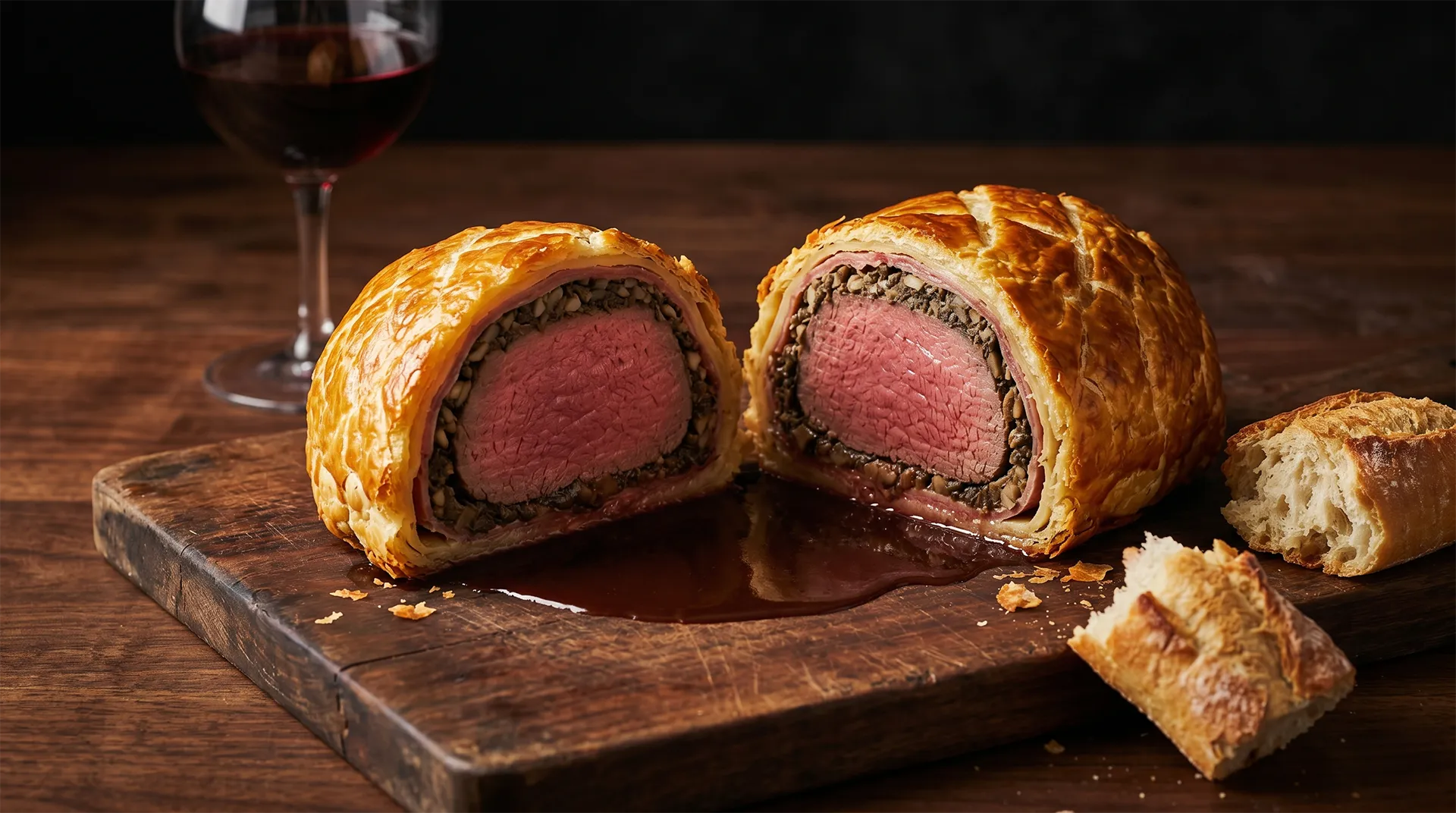
Chapter 7 · The Butcher
Individual Beef Wellington
Tender beef tenderloin encased in savory duxelles, prosciutto, and Boursin cheese, all wrapped in a shattering puff pastry crust — a composed centerpiece built from classical French technique.
Yield: 4 portions | Prep: 45 min | Inactive: 1 hr 20 min | Cook: 30 min | Total: ~2 hr 35 min
Headnote
The Wellington is one of the most technically demanding compositions in the home cook’s repertoire — not because any single step is difficult, but because every element must be executed in sequence and at the correct temperature before the next begins. The duxelles must be bone-dry and fully cold. The fillet must be seared, rested, and fully cold. The pastry must be chilled until the moment it wraps. Warmth at any stage is the enemy of a shatteringly crisp crust. Teaching Idea: The Moisture Stack. Every layer in this Wellington — prosciutto, duxelles, Boursin — serves a structural function beyond flavor. The prosciutto acts as a fat barrier, preventing mushroom moisture from contacting the pastry directly. The Boursin provides a fatty adhesive layer that bonds the fillet to the filling and seasons from the inside out. Together, they protect the pastry from sogging while the fillet reaches temperature.
Ingredients
The Fillets
- 4 beef tenderloin fillets, 6–7 oz (170–200g) each, approximately 2 inches thick
- Diamond Crystal kosher salt, for pre-salting
- 15 ml (1 tbsp) grapeseed oil
The Duxelles
- 340 g (12 oz) cremini mushrooms, hand-chopped to ¼-inch pieces
- 2 medium shallots, thinly sliced
- 4–6 garlic cloves, minced
- 10 g (2 tbsp) fresh thyme leaves
- 28 g (2 tbsp) unsalted butter
- 15 ml (1 tbsp) grapeseed oil
- 30 ml (2 tbsp) Worcestershire sauce
- Diamond Crystal kosher salt and black pepper, to taste
The Assembly
- 8 slices prosciutto di Parma (2 per Wellington)
- 1 package (5.2 oz / 150g) Boursin Garlic & Fine Herbs, quartered
- 1 batch puff pastry, rolled to ¼-inch thick, cut into four 6-inch squares (See 12-05 Pâte Feuilletée or 12-06 Rough Puff Pastry — 12-06 recommended)
- 1 large egg, beaten with 1 tsp water (egg wash)
The Madeira Sauce
- 57 g (¼ cup) unsalted butter
- 30 g (¼ cup) all-purpose flour
- 2 garlic cloves, minced
- 8 g (1 tbsp) fresh thyme leaves
- 120 ml (½ cup) Madeira wine (see Wine Selection table in Chef’s Notes)
- 480 ml (2 cups) beef broth — or substitute 120 ml (½ cup) with demi-glace from 10-19 for a deeper, more refined sauce; see also 10-17 Fond Brun as the broth base
- Diamond Crystal kosher salt and black pepper, to taste
Mise en Place (Action Checklist)
- Pre-salt the fillets: Season generously with Diamond Crystal kosher salt 45 minutes before cooking. Leave uncovered at room temperature. Pat bone dry with paper towels immediately before searing.
- Chop the mushrooms: Hand-chop to ¼-inch pieces. Do not use a food processor — the blade releases too much water and produces a paste rather than a textured duxelles.
- Prep the aromatics: Slice shallots thinly; mince garlic (kept separate from shallots — it goes in last).
- Roll and chill the pastry: Roll puff pastry to ¼-inch thickness. Cut 4 squares, approximately 6 inches per side. Place on a parchment-lined tray and refrigerate for 1 hour before use.
- Divide the Boursin: Quarter one package into 4 equal portions. Keep refrigerated until assembly.
- Prepare the egg wash: Whisk 1 large egg with 1 tsp water. Set aside.
- Preheat the oven: 400°F/205°C, with a rack in the upper-middle position.
Method
Phase 1: Build the Duxelles
In a wide skillet, melt the butter with the grapeseed oil over medium-high heat until the foam subsides. Add the shallots and cook for 2–3 minutes until softened. Add the mushrooms and spread into a single layer. Cook without stirring for 2 minutes, then stir and continue cooking until all moisture has fully evaporated — the pan should be dry, the mushrooms reduced to a dark, concentrated mass, approximately 10–12 minutes total.
Add the garlic and thyme. Cook for 1 minute until fragrant. Deglaze with Worcestershire sauce and reduce completely until the pan is dry again — no moisture should remain.
Season with salt and pepper. Spread the duxelles onto a sheet tray in a thin, even layer and cool to full room temperature before assembly. Do not rush this step.
Phase 2: Sear the Fillets
Pat the pre-salted fillets completely dry with paper towels. Heat a cast iron or heavy stainless skillet over high heat until smoking. Add grapeseed oil, then sear fillets 60–90 seconds per side, including the edges, until a deep mahogany crust forms on all surfaces.
Transfer to a wire rack set over a sheet tray. Allow to cool completely to room temperature before wrapping — approximately 20–30 minutes. The fillet must be cold at the center before it contacts the pastry.
Phase 3: Assemble the Wellingtons
Lay a sheet of plastic wrap on your work surface. Arrange 2 slices of prosciutto slightly overlapping into a rectangle large enough to wrap one fillet (approximately 6 × 8 inches). Spread one portion of duxelles over the prosciutto in an even layer, sized to the footprint of the fillet. Spread one portion of Boursin over the duxelles.
Place one cooled fillet at the near edge of the prosciutto. Using the plastic wrap, roll the prosciutto tightly around the fillet, twisting the ends firmly to form a compact cylinder. Refrigerate the wrapped roulades for 20 minutes to set their shape.
Remove the chilled pastry squares from the refrigerator. Remove plastic from a roulade and place it at the center of one pastry square. Fold the pastry up and over, sealing the seam underneath. Press the ends to seal. Place seam-side down on a parchment-lined baking sheet. Repeat for all four.
Work quickly — the pastry must stay cold throughout this process.
Phase 4: Egg Wash and Score
Brush all surfaces of each Wellington evenly with egg wash. Using a sharp paring knife, score the top of the pastry in your chosen pattern — diagonal crosshatch, herringbone, or feather — cutting no more than ⅛-inch deep. Do not cut through to the filling.
Note: If applying decorative pastry cutouts, egg wash the base layer first, apply cutouts, then egg wash the entire surface again. Cutouts that are not egg-washed will overbrown; cover with a small foil tent during the final 5 minutes if needed.
Refrigerate the assembled Wellingtons for 10–15 minutes while the oven reaches temperature.
Phase 5: Bake and Rest
Insert a probe thermometer into the center of one Wellington positioned in the back of the oven (the most even-heat position). Bake at 400°F/205°C, monitoring the probe continuously.
| Doneness | Pull Temp | Est. Time | Resting Temp |
|---|---|---|---|
| Rare | 115°F/46°C | 16–18 min | 120°F/49°C |
| Medium-Rare (recommended) | 125°F/52°C | 20–22 min | 130–135°F/54–57°C |
| Medium | 135°F/57°C | 24–26 min | 140°F/60°C |
Times are estimates for 2-inch fillets starting from fully chilled. Trust the probe, not the clock.
When the target pull temp is reached, remove from the oven. Transfer to a wire rack and rest uncovered for 8–10 minutes. The pastry will continue to crisp as steam escapes. Do not tent with foil — it will soften the crust.
Phase 6: Build the Madeira Sauce
In a heavy saucepan over medium heat, melt the butter. Add the flour and stir continuously with a wooden spoon until the mixture resembles damp sand and smells faintly nutty, about 2 minutes. Add the garlic and thyme and cook for 30 seconds.
Deglaze with Madeira (or your chosen wine — see Chef’s Notes). Stir vigorously as the mixture tightens into a paste. Cook until the wine aroma mellows, about 1 minute.
Add the beef broth in a steady stream, whisking constantly to break up the roux. Bring to a gentle simmer and cook on low heat for 10 minutes, whisking occasionally, until the sauce coats the back of a spoon (nappé). Season with salt and pepper.
If using demi-glace (10-19): Replace 120 ml (½ cup) of the broth with demi-glace, added with the remaining broth. Reduce simmer time to 6–7 minutes — the sauce will thicken faster.
Serve in a warmed gravy boat or sauce ramekin alongside each Wellington.
Chef’s Notes
- 10-17 Pressure-Roasted Brown Stock (Fond Brun): Use as your beef broth base for significantly more body and depth.
- 10-19 Classic Demi-Glace: Replace 120 ml (½ cup) of the broth with demi-glace. Reduce simmer time to 6–7 minutes. The result is a glossy, restaurant-grade pan sauce.
Glossary
- Duxelles: A finely chopped mushroom preparation cooked until all moisture has evaporated, resulting in a concentrated, nearly dry paste used as a filling or flavoring base.
- Maillard Reaction: The chemical reaction between amino acids and reducing sugars at high heat that produces the complex flavors and dark color of seared meat. Requires a dry surface — moisture inhibits the reaction.
- Prosciutto di Parma: An Italian dry-cured ham aged a minimum of 400 days. In this context, used as a moisture barrier and flavor layer between the duxelles and the pastry.
- Roulade: A preparation rolled into a tight cylinder, typically using plastic wrap to compress and shape during chilling.
- Velouté: One of the five French mother sauces. A blonde roux (butter + flour) finished with a light stock. The Madeira sauce in this recipe is built on a velouté base.
- Nappé: The consistency at which a sauce coats the back of a spoon and a clean line holds when you draw your finger through it. The target consistency for the Madeira sauce.
- Demi-Glace: A rich, reduced sauce made from brown stock and Sauce Espagnole, cooked until it coats heavily. Used here as a sauce intensifier (see 10-19).
- Lamination: The layered structure of puff pastry created by repeated folding of butter into dough. Heat converts butter moisture to steam, separating the layers and creating lift and crispness.