Chapter 8 · The Field
The Quintessential Dolma Guide
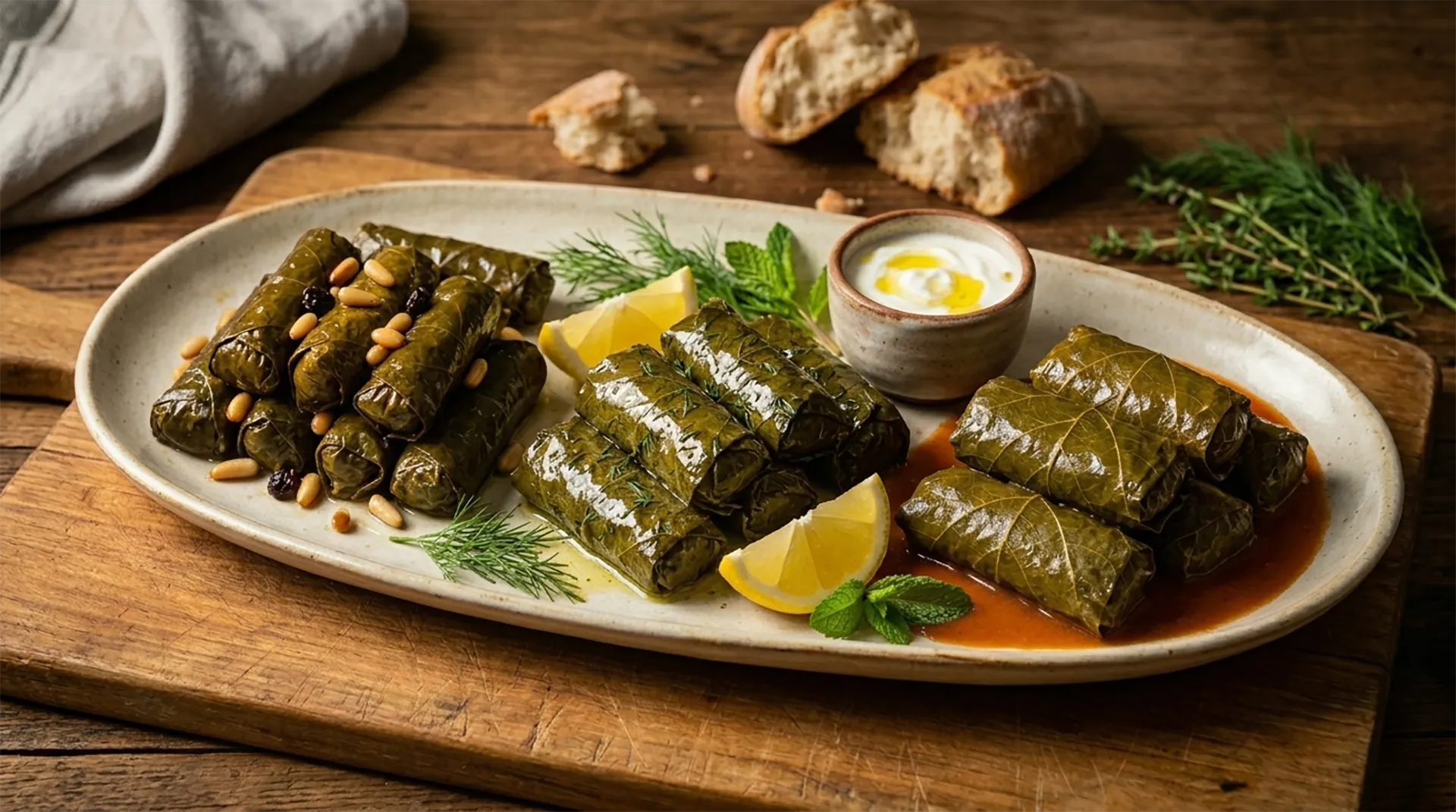
A comprehensive study in stuffed grape leaves across three culinary traditions — Turkish cold rice, Greek herb-forward, and Armenian/Georgian braised lamb.
Yield: 20–24 pieces (serves 6–8 as meze) | Prep: 45 min | Inactive: 30 min | Cook: 55 min | Total: ~2 hr
Headnote
The dolma is one of the oldest prepared foods in the Mediterranean world, and the argument over who owns it has never been settled. What is settled is the technique: a tight, compact roll of seasoned filling enclosed in a leaf and braised until the wrapper and filling become one cohesive unit. The differences between traditions live entirely in the filling philosophy — the Turkish version uses rice as a vehicle for spice and dried fruit, the Greek version adds assertive herbs and a punishing quantity of olive oil, and the Armenian/Georgian version abandons rice as the primary anchor and builds around braised ground lamb. Master the roll and the braise, and all three are within reach.
Teaching Idea: The Braise as Steam Trap. When dolmas are packed tightly seam-side down and weighted in the pot, they braise in a closed steam environment. The liquid never fully submerges them — it generates steam that cooks from below while condensation cooks from above. This is why the lid and the weight (an inverted plate) are non-negotiable: without them, the tops dry out and the rolls lose structural integrity.
Ingredients
Shared Components
- 35–40 Fresh grape leaves (or 1 jar brine-packed, rinsed and soaked 15 min)
- 1 Lemon, sliced into rounds (for lining the pot)
Turkish Filling — Zeytinyağlı (Vegetarian)
- 200 g (1 cup) Short-grain white rice, soaked and drained
- 80 ml (⅓ cup) Extra virgin olive oil, divided
- 1 Large yellow onion, fine brunoise
- 2 Shallots, fine brunoise
- 40 g (3 tbsp) Dried currants
- 35 g (3 tbsp) Pine nuts, toasted
- 8 g (1½ tsp) Diamond Crystal kosher salt
- 4 g (1 tsp) Ground allspice
- 3 g (¾ tsp) Ground cinnamon
- 2 g (½ tsp) Ground black pepper
- 2 g (½ tsp) Dried mint
- 1 g (¼ tsp) Ground cumin
- 30 ml (2 tbsp) Fresh lemon juice
- 1 Lemon, zest only
- 240 ml (1 cup) Water (for braising)
Greek Filling — Dolmades
Start from the Turkish base above and make these changes:
- Replace dried mint with 10 g (¼ cup) fresh dill, chopped and 8 g (3 tbsp) fresh mint, chopped
- Increase olive oil to 120 ml (½ cup) — use all of it in the filling, not split for braising
- Add 4 spring onions (scallions), fine sliced
- Omit currants and cumin
- Add 15 ml (1 tbsp) fresh lemon juice directly to filling (in addition to braising liquid)
Armenian/Georgian Filling — Lamb Braise
- 450 g (1 lb) Ground lamb (80/20 fat ratio)
- 150 g (¾ cup) Short-grain white rice, soaked and drained
- 1 Medium yellow onion, fine brunoise
- 45 ml (3 tbsp) Olive oil
- 8 g (1½ tsp) Diamond Crystal kosher salt
- 5 g (1 tsp) Ground allspice
- 4 g (¾ tsp) Ground cinnamon
- 2 g (½ tsp) Ground black pepper
- 2 g (½ tsp) Sweet paprika
- 1 g (¼ tsp) Cayenne pepper
- 240 ml (1 cup) Crushed San Marzano tomatoes
- 240 ml (1 cup) Water
- 15 ml (1 tbsp) Fresh lemon juice
Mise en Place (Action Checklist)
Leaf Preparation (Fresh — Primary Method):
- Have an ice bath ready.
- Trim any thick stems flush with the leaf base with scissors.
Filling Prep (All Variants):
- Soak the rice in cold water for 20 minutes, then drain and rinse until the water runs clear.
- Dice all aromatics (onion, shallot) to a fine, uniform brunoise.
- Zest and juice the lemons. Keep separate.
- Have a heavy, flat-bottomed pot wide enough to fit rolls in a single layer, and an inverted plate sized to fit inside it, ready before you begin rolling.
Method
Phase 0 — Prepare Fresh Grape Leaves (if using fresh)
Bring a large pot of salted water to a boil. Have an ice bath ready. Working in batches of 6–8, blanch fresh grape leaves for 30–45 seconds — just until they turn from bright to olive green and become pliable. Do not exceed 60 seconds. Transfer immediately to the ice bath. Pat completely dry before rolling.
If using jarred leaves: Rinse thoroughly, soak in cold water for 15 minutes, and pat completely dry. Proceed directly to Phase 1.
Phase 1 — Build the Turkish Filling
-
Toast the Pine Nuts: In a dry skillet over medium heat, toast the pine nuts, stirring constantly, until golden, about 2–3 minutes. Set aside to cool.
-
Sweat the Aromatics: Heat 40 ml of the olive oil in a wide skillet over medium heat. Add the onion and shallots with a pinch of salt. Cook, stirring occasionally, for 10–12 minutes until completely soft and translucent — no color. The onion must be fully cooked before the rice goes in; raw onion will never fully soften inside the roll.
-
Toast the Spices: Add the allspice, cinnamon, cumin, black pepper, and dried mint directly to the onion. Stir constantly for 60 seconds until fragrant. You are blooming the spices in the residual fat.
-
Build the Filling: Add the drained rice, currants, toasted pine nuts, lemon zest, and lemon juice. Stir to combine thoroughly. Season, taste, and adjust salt — the filling should be assertively seasoned at this stage, as the rice will absorb and mellow flavor during the braise.
Sensory Cue: The mixture should smell complex — warm spice, citrus, and toasted nut simultaneously. If it smells flat, add a pinch more allspice.
-
Cool: Spread the filling on a sheet tray and cool to room temperature before rolling. Hot filling will steam the leaves from the inside during assembly and make them difficult to handle.
Phase 2 — Roll
-
Prepare the Pot: Line the bottom of your braising pot with the lemon rounds. This prevents the bottom layer of dolmas from scorching and adds brightness to the braising steam.
-
Roll Technique: Place a leaf vein-side up on your work surface, stem end toward you. Place 1 heaped teaspoon (about 15 g) of filling in the center, just above the stem junction. Do not overfill — the rice will expand during cooking and an overfilled roll will burst.
Fold the bottom of the leaf up over the filling. Fold both sides in toward the center. Roll firmly away from you, keeping even tension throughout. The roll should feel snug but not compressed.
Sensory Cue: A properly rolled dolma holds its shape when you release it without unraveling. If it unravels, your filling-to-leaf ratio is off or the leaf was too wet.
-
Pack the Pot: Place each finished roll seam-side down in the pot, packing them tightly against each other in concentric rows. Tight packing is structural — the rolls brace each other and prevent unraveling during the braise. Add a second layer if needed.
Phase 3 — Braise
-
Add Braising Liquid: Combine the remaining 40 ml of olive oil, 240 ml water, and a squeeze of lemon juice. Pour over the rolls — the liquid should reach about halfway up the first layer, not submerge them.
-
Weight and Seal: Place an inverted plate directly on top of the rolls to keep them submerged and stationary. Cover the pot with a tight-fitting lid.
-
Braise: Bring to a gentle simmer over medium heat, then reduce to low. Cook for 40–45 minutes. Do not lift the lid during cooking.
Sensory Cue: At 40 minutes, lift the lid and pierce one roll with a thin skewer. The rice should offer no resistance — if it catches, re-seal and cook 5 more minutes.
-
Rest: Remove from heat and allow to rest, covered, for 20 minutes. The Turkish and Greek versions are served at room temperature or cold — transfer to a platter and finish with a drizzle of good olive oil and lemon wedges.
Phase 4 — Greek Variant Adjustments
- The Greek filling is built identically to the Turkish (Phase 1–3) with the ingredient substitutions listed above. Because the olive oil quantity is nearly doubled, the filling will look looser and more unctuous before rolling. This is correct — the oil distributes through the rice during the braise and produces a noticeably silkier texture in the finished roll. Do not add flour or starch to tighten it.
Phase 5 — Armenian/Georgian Variant
-
Brown the Lamb: Heat olive oil in a wide skillet over high heat. Add the ground lamb and cook without stirring for 2–3 minutes until a deep brown crust forms on the bottom. Break apart and continue cooking until no pink remains. Drain excess fat, leaving approximately 1 tablespoon in the pan.
Sensory Cue: You want Maillard color on the meat — grey lamb is under-developed and will produce a flat filling.
-
Build the Filling: Reduce heat to medium. Add the onion and cook until softened, 6–8 minutes. Add allspice, cinnamon, paprika, cayenne, and black pepper — bloom 60 seconds. Add the drained rice and stir to coat in the spiced fat. Season and cool completely before rolling.
-
Braise Liquid: The Armenian/Georgian version braises in crushed tomato thinned with water (1:1 ratio) plus lemon juice rather than the olive oil-water combination. This produces a more acidic, deeply colored braise that complements the lamb. Method is otherwise identical — line with lemon, pack tight, weight, cover, 45–50 minutes.
Sensory Cue: The braising liquid will reduce to a thick, rust-colored sauce around the rolls. Spoon it over when serving hot.
Chef’s Notes
- On Jarred Grape Leaves: Brine-packed jarred leaves are more pliable and forgiving to roll than fresh — the curing process softens the cell structure. The tradeoff is higher sodium and a slightly softer finished texture. If using jarred: rinse thoroughly, soak in cold water for 15 minutes, and pat completely dry. Reduce added salt in the filling by approximately 25% to compensate for residual brine.
- On Rice Selection: Short-grain white rice (such as Calrose or a basic sushi rice) is traditional and produces a slightly stickier, more cohesive filling that holds the roll’s shape. Long-grain (basmati) produces a more separate, fluffy interior with a drier texture. Both work — short-grain is recommended for beginners because it binds more forgivingly. Do not use parboiled or instant rice; it will not absorb the braising liquid correctly.
- On Currants: Dried currants are traditional and deliver a sharper, more concentrated fruit hit than raisins. If substituting raisins, chop them roughly before adding — whole raisins create uneven pockets of sweetness in the filling.
- On Pine Nuts: Toasting is non-negotiable for flavor development. Raw pine nuts are bland and waxy inside a braise. Toast in a dry skillet over medium heat, watching constantly — they go from golden to burnt in under 30 seconds.
- On Scaling: The filling and leaf quantities scale linearly at 2x or 4x without adjustment. Two variables require attention at scale: (1) Braise liquid — do not simply multiply. Add enough liquid to reach halfway up the first layer, then keep extra hot water nearby. (2) Rolling time is purely labor — budget 20–25 minutes per batch of 24 regardless of scale.
- On Make-Ahead: The Turkish and Greek versions improve significantly after 24 hours in the refrigerator — the spices and olive oil continue to develop. Make them a day ahead whenever possible. The Armenian/Georgian version reheats well covered in its braising liquid over low heat.
Glossary
- Zeytinyağlı: Turkish term for dishes cooked in and served with olive oil, typically at room temperature. Literally “with olive oil.”
- Dolmades: The Greek term for stuffed grape leaves. From the Turkish dolma, meaning “stuffed thing.”
- Brunoise: A fine dice of approximately 3mm × 3mm × 3mm. The standard for aromatics that must cook evenly and disappear into a filling.
- Blooming: The process of briefly heating spices in fat to volatilize aromatic compounds and amplify flavor. Done correctly, it takes 45–90 seconds and produces a noticeably more complex fragrance than adding spices to liquid.
- Maillard Reaction: A chemical reaction between amino acids and reducing sugars that produces browning and hundreds of flavor compounds. Requires surface temperatures above approximately 280°F/140°C — only achievable on a dry surface. Relevant here to the lamb browning step.
- Meze: A selection of small dishes served as appetizers or a light meal across Mediterranean and Middle Eastern cuisines. The traditional context for dolmas.