Chapter 11 · Spice Blends, Oils & Pastes
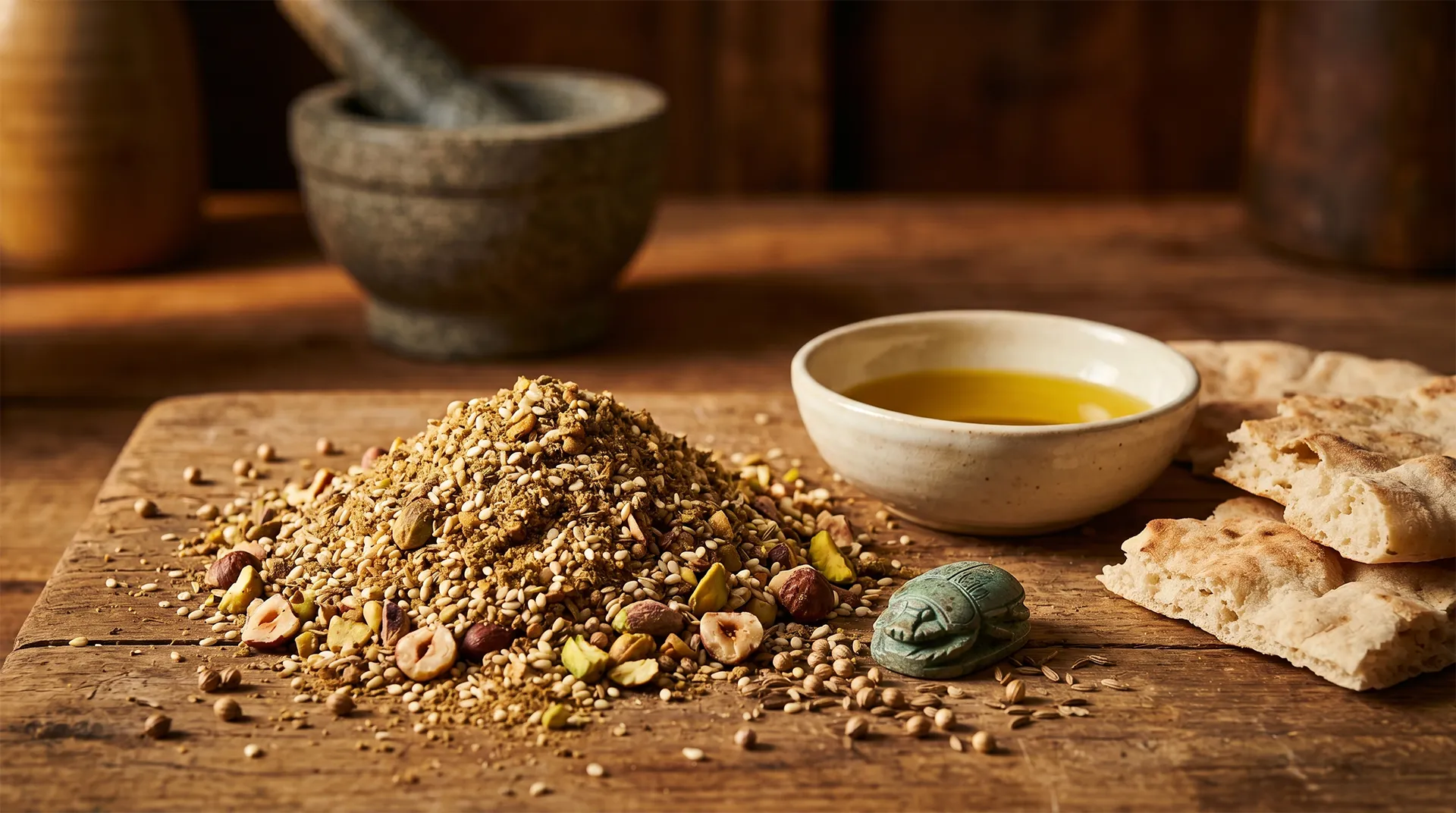
Dukkah (Cairo Market Blend)
An Egyptian nut-and-spice blend built for the bread-and-oil ritual — coarse, aromatic, and vendor-specific by design.
Yield: ~175 g (about ¾ cup) | Prep: 10 min | Cook: 20 min | Total: 30 min
Headnote
Dukkah is what happens when a spice route runs through a working-class kitchen. The name comes from the Arabic “to pound,” and the blend has been street food, field ration, and morning staple across Egypt for centuries — eaten by everyone from laborers to merchants, pressed into bread dipped in olive oil and handed across a market counter. The oldest documented compositions were nut-free: just sesame seed, coriander, cumin, dried herbs, and salt. Hazelnuts and almonds entered the blend later, as nuts became more accessible in the Cairo markets, and today every vendor’s version is different — that variation is not a weakness, it is the point. There is no canonical dukkah; there are only dukkah recipes, and this is Café Athena’s. Teaching Idea: Three-Phase Toasting. Nuts, seeds, and whole spices have different moisture levels and volatile aromatic compounds, so they burn at different rates. Toasting each component separately in sequence — nuts first, seeds second, spices last — gives you full control over each phase and prevents the lighter spices from scorching while waiting for the hazelnuts to finish.
Ingredients
The Nut Layer
- 80 g raw hazelnuts, skin-on
- 20 g shelled unsalted pistachios
The Seed Layer
- 40 g white sesame seeds
The Spice Layer
- 15 g whole coriander seed
- 8 g whole cumin seed
- 5 g dried thyme (or dried wild marjoram)
Seasoning
- 8 g Diamond Crystal kosher salt
- 3 g freshly ground black pepper
Mise en Place
- Set oven to 350°F/175°C.
- Line a rimmed baking sheet with parchment.
- Lay out a clean kitchen towel for hazelnut skin removal.
- Measure and set aside all remaining ingredients in separate small bowls.
- Set a food processor on the counter; do not fit the bowl yet.
Method
Phase 1: Roast and Skin the Hazelnuts
Spread the hazelnuts in a single layer on the prepared baking sheet. Roast at 350°F/175°C for 12–15 min, until the skins are visibly cracking and the nuts are fragrant and lightly golden beneath the skin. Transfer immediately to the center of the kitchen towel, fold the towel over the nuts, and rub vigorously for 30–45 seconds. The skins will not come off completely — that is expected. Aim for 70–80% removal; the residual skin adds a faint bitterness that sharpens the blend. Spread the skinned hazelnuts on the baking sheet and let cool completely to room temperature, at least 10 min.
Why: The steam produced during roasting loosens the pellicle (the paper-thin skin). Towel-rubbing while hot captures that loosening; cooling the nuts fully before processing prevents the residual heat from driving the food processor toward paste.
Phase 2: Toast the Pistachios
In a dry skillet over medium heat, add the pistachios and toast, stirring constantly, for 3–4 min until lightly golden at the edges and fragrant. Transfer to a plate and cool completely.
Phase 3: Toast the Sesame Seeds
Return the skillet to medium heat. Add the sesame seeds and toast, stirring constantly, for 2–3 min until golden and beginning to pop. The moment you hear consistent popping and the seeds have turned a uniform straw-gold, pull them off the heat. Transfer to a plate and cool completely.
Why: Sesame seeds are thin and high in oil — they go from golden to bitter very quickly. Pull at first pop.
Phase 4: Toast the Whole Spices
Return the skillet to medium-low heat. Add the coriander seed and cumin seed together. Toast, stirring constantly, for 60–90 seconds until fragrant and the coriander just begins to darken at the edges. Add the dried thyme in the final 15 seconds, toss once, and transfer everything to a plate. Cool completely.
Why: Whole coriander and cumin are denser than dried herb leaf and need more time. Adding the thyme last prevents it from scorching.
Phase 5: Pulse to Texture
Fit the food processor bowl. Add the cooled hazelnuts and pistachios. Pulse 4–5 times in 1-second bursts — the goal is coarse rubble, not powder. Add the sesame seeds, toasted spices, salt, and black pepper. Pulse another 4–6 times, checking after each pulse. Stop when the blend is coarse-sandy: distinct hazelnut fragments visible, no dust, no nut butter. The texture should clump slightly when pressed between two fingers but break apart easily.
Critical grind check: If the processor runs continuously for more than 3 seconds, you are heading toward paste. Stop immediately, scrape the bowl, and assess. Paste cannot be reversed.
Phase 6: Taste and Adjust
Dip a piece of bread in olive oil, press it into a small pile of the blend, and taste. The blend should be nutty, warmly spiced, faintly herbal, and savory. Adjust salt if needed. Use immediately or transfer to an airtight jar.
Variations
Foundation Blend (The Ancient Core)
The oldest documented version of dukkah — nut-free, built entirely from seed, dried herb, and salt. The grain is finer and the flavor is sharper and more distinctly herbaceous. This is the correct base if you need the blend to be nut-free.
Omit the hazelnuts and pistachios entirely. Use the same weights and method for the sesame seeds and spice layer. In Phase 5, pulse to a coarse-fine powder — more integrated than the Cairo Market version, since there are no nut fragments to anchor texture. Target: dry and loosely sandy, not clumping.
Almond Variation
A regional alternate common in some Egyptian households and North African markets. Substitute 80 g raw skin-on almonds for the hazelnuts — no oven roasting required. Toast the almonds in the skillet over medium heat for 6–8 min, stirring constantly, until golden and fragrant. No towel-rubbing; almond skins are thinner and more tightly adhered. Proceed from Phase 2 identically.
Dukkah as a Crust
Pack the blend firmly onto a lamb rack or bone-in chicken thigh after a thin brush of Dijon mustard, which acts as a binder. Roast as directed by the protein recipe. The nut-and-seed matrix toasts further in the oven and sets into a crackling crust. A full Egyptian lamb rack recipe using this blend will appear in Ch. 7 — The Butcher.
Chef’s Notes
- The bread-and-oil ritual: Tear bread, dip in good olive oil, press the oiled surface into a small pile of dukkah. Eat immediately. That is the recipe.
- Other applications: Spoon over labneh or hummus as a finishing layer. Press onto a soft-boiled egg. Use as a finishing blend over roasted carrots or beets. Fold into yogurt as a dip base.
- Mortar and pestle: The traditional method. Work the cooled nuts and spices in stages, grinding with a rocking motion rather than a pounding one — dukkah is not a paste. The mortar gives you finer control over texture and produces a slightly more integrated result than the food processor. Use it if you have one.
- Storage: Airtight jar at room temperature, up to 2 weeks. Refrigerate for up to 6 weeks. The sesame oils will go rancid if left in a warm kitchen; smell before using — a sharp or paint-like note means it has turned.
- Make-ahead: The blend improves after a few hours as the flavors integrate. Make it the morning of service. Do not make it more than a day in advance if using the mortar method; the texture softens faster.
- Nut substitutions: Almonds (see Variations), walnuts, or macadamia are all usable in a pinch. Walnuts are more bitter and will dominate; macadamia are sweeter and roast faster. Neither is traditional.
Glossary
- Pellicle: The thin, papery outer skin of a nut (hazelnut, almond) that lies beneath the outer shell. In hazelnuts, the pellicle is tannic and slightly bitter; partial removal is preferable to full removal for flavor complexity.
- Bloom (aromatic): The release of volatile aromatic compounds from a spice through the application of dry heat. Toasting whole spices in a dry skillet blooms the essential oils locked in the seed’s cell walls, amplifying flavor intensity before grinding.
- Volatile aromatic compounds: Flavor molecules in spices and herbs that evaporate readily at elevated temperatures. This is why ground spices smell most intensely at the moment of grinding and why overcooked spices lose aromatic potency.
- Mise en place: French for “everything in its place.” The practice of measuring, prepping, and organizing all ingredients before cooking begins.
- Labneh: Strained yogurt cheese common across the Levant and North Africa. Made by suspending yogurt in cheesecloth until the whey drains and the yogurt thickens to a spreadable, tangy, cream-cheese-like consistency.