Chapter 6 · The Poulterer
Chicken Christopher (Panko Cutlet, Beurre Blanc)
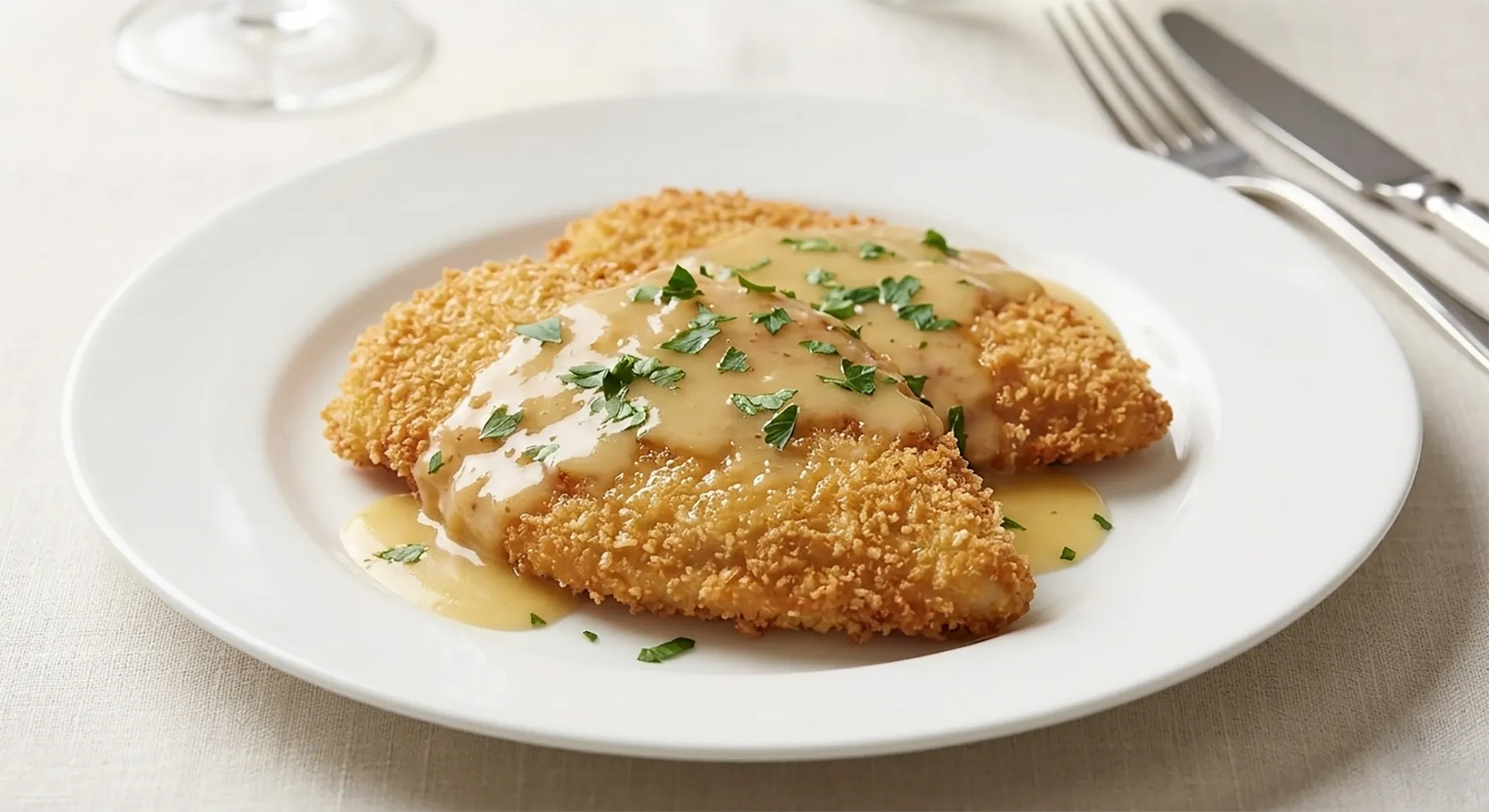
A golden panko-crusted cutlet built on the paillard method, finished with a warm butter emulsion drawn from white wine, shallot, and acid.
Yield: 2 servings | Prep: 20 min | Cook: 25 min | Total: 45 min
Headnote
Chicken Christopher is a hotel-kitchen formula at its most honest — a pounded breast, a clean three-stage breading, and one of the great French sauces. The beurre blanc is the thing. It is not a béchamel or a hollandaise; it is an emulsification of cold butter into a hot acidic reduction, and it holds only because it never gets hot enough to break. The butter goes in cold, piece by piece, over medium-low heat, and the acid in the reduction — the wine and vinegar — acts as a stabilizer. Push the temperature above 180°F and the emulsion separates into grease. Pull it before all the butter is incorporated and the sauce is thin. The window is real, but not narrow once you’ve done it twice.
Teaching Idea: The Standard Breading Procedure. Flour → egg → panko is one of the most repeated sequences in professional cooking, and each stage has a job. The flour dries the protein surface and gives the egg something to grab. The egg provides adhesion — without it, panko beads off the cutlet in the pan. Panko itself is pre-dried and coarse, which means it fries to a far crisper texture than fine breadcrumbs; its open cellular structure lets steam escape rather than trapping it, which is what causes sogginess in a breaded cutlet.
Ingredients
The Chicken
- 2 boneless, skinless chicken breasts (approx. 450 g / 1 lb total)
- Diamond Crystal kosher salt and coarse-ground black pepper
- 150 g (1¼ cups) all-purpose flour
- 2 large eggs, beaten
- 150 g (1½ cups) panko breadcrumbs
- 30 g (2 tbsp) unsalted butter
- 30 ml (2 tbsp) neutral oil — grapeseed or canola
The Beurre Blanc
- 1 medium shallot (approx. 30 g), very finely minced
- 60 ml (¼ cup) dry white wine or dry vermouth
- 60 ml (¼ cup) white wine vinegar
- 113 g (1 stick / 8 tbsp) unsalted butter, cut into 16 pieces and refrigerated
- Diamond Crystal kosher salt and white pepper, to taste
- 1 g (¼ tsp) fresh lemon zest
- 30 ml (2 tbsp) dry white wine, optional — reserved for deglazing the pan after frying
Garnish
- Flat-leaf parsley, finely chopped
Mise en Place
- Set up the breading station: three shallow bowls — flour in the first, beaten eggs in the second, panko in the third.
- Cut the beurre blanc butter into 16 pieces (approximately ½ tbsp each), refrigerate on a small plate, and keep refrigerated until Phase 5 — it must be cold when it goes into the sauce.
- Mince the shallot as finely as possible — smaller pieces dissolve more completely during the beurre blanc reduction in Phase 3.
- Set a wire rack over a rimmed sheet pan for draining and resting the finished cutlets.
Method
Phase 1 — Prep the Cutlets
-
Place one chicken breast flat on a cutting board. Holding a sharp knife parallel to the board, slice the breast in half horizontally to produce two even pieces — four cutlets total from both breasts. Take your time with this cut; a slow, even draw produces a cleaner split than sawing.
-
Place each cutlet between two sheets of plastic wrap. Using the flat face of a meat mallet or the bottom of a heavy skillet, pound each piece to an even thickness of approximately 6 mm (¼ inch). Work from the center outward in smooth, overlapping strokes — this stretches the muscle fibers rather than tearing them.
Why: Chicken breast is geometrically uneven — thick at the lobe, thin at the tail. Pan-fried as-is, the thin end overcooks before the thick end is safe. Slicing and pounding equalizes the geometry so that every part of the cutlet reaches temperature simultaneously.
-
Season both sides of each cutlet with Diamond Crystal kosher salt and coarse-ground black pepper. Rest on the rack for 5 minutes while you finalize the breading station.
Phase 2 — Bread the Cutlets
-
Working one cutlet at a time: drag through the flour, pressing lightly to coat all surfaces. Shake off the excess — a thin, even flour film is the goal, not a caked layer.
-
Dip the floured cutlet into the beaten egg, letting the excess fall away. The egg should coat the surface completely without pooling.
-
Press the egg-coated cutlet firmly into the panko, turning and pressing again to embed the crumbs into the surface. No bare patches. Set on the wire rack and repeat with remaining cutlets.
Why: Each stage builds on the previous one. The flour’s starch gives the egg traction; the egg’s proteins bond with the panko and set firm during frying. Pressing is not optional — panko that isn’t embedded into the egg layer will shed in the pan.
Phase 3 — Start the Beurre Blanc Reduction
-
Combine the minced shallot, white wine, and white wine vinegar in a small heavy-bottomed saucepan. Bring to a simmer over medium heat.
-
Reduce, stirring occasionally, until approximately 2 tablespoons of liquid remain and the shallot looks soft and jammy, about 5–7 minutes.
-
Remove from heat and set aside off the burner.
Note: Begin this reduction at the same time you start frying the first batch of cutlets. It holds off heat without issue while you fry; you’ll mount the butter after the last cutlet comes out of the pan.
Phase 4 — Fry the Cutlets
-
Set a large heavy skillet — cast iron or stainless — over medium-high heat. Add the butter and oil together and wait until the foam subsides and the fat shimmers. Do not allow the butter to brown before the cutlets go in.
Why: Butter alone burns at temperatures above 300°F (149°C). Combining it with oil raises the effective smoke point of the fat mixture, extending the browning window. The butter contributes flavor; the oil contributes heat stability.
-
Add two cutlets — do not crowd the pan. Cook undisturbed for 3–4 minutes until the underside is deep golden. Flip once and cook 2–3 minutes on the second side until the internal temperature reaches 165°F / 74°C.
-
Transfer to the wire rack.
-
Season immediately with a pinch of Diamond Crystal kosher salt while the crust is still hot.
-
Repeat Steps 2–4 with the remaining two cutlets, seasoning each as it comes off the pan.
Optional: Deglaze the pan with the reserved 30 ml white wine, scraping up the fond. Pour the deglazed liquid into the shallot reduction before mounting the butter — it adds depth and integrates the cooking flavors.
Phase 5 — Mount the Beurre Blanc
-
Return the shallot reduction to medium-low heat. When the reduction just begins to bubble gently, add 2 pieces of cold butter and whisk constantly until melted and incorporated. Add 2 more pieces. Continue in this pattern — always whisking, never adding more until the previous addition has fully emulsified.
-
Continue until all 16 pieces have been incorporated and the sauce is glossy and coats the back of a spoon. The target temperature range is 160–175°F (71–80°C). Do not exceed this — above 180°F the emulsion breaks.
-
Remove from heat. Season with salt and white pepper. Whisk in the lemon zest.
Why the butter must be cold: Cold butter melts gradually, releasing fat and water slowly enough for the butterfat’s lecithin to act as an emulsifier. Room-temperature or softened butter melts all at once and overwhelms the emulsion, causing the sauce to break into a greasy pool.
On straining: The shallot pieces can be left in — they add texture and sweetness — or strained through a fine-mesh sieve for a cleaner, more classical presentation. Both are defensible. Strain for a restaurant plate; leave them in for depth.
Phase 6 — Plate
-
Arrange two cutlets on each plate, slightly overlapping.
-
Spoon the beurre blanc generously over the cutlets — enough to coat, not enough to pool.
-
Finish with chopped flat-leaf parsley. Serve immediately.
Chef Notes
- Holding the sauce: Beurre blanc does not hold well. Once mounted, keep it warm — not hot — over the lowest burner, whisking occasionally. It should be served within 5 minutes. A small addition of cream (15 ml / 1 tbsp) stirred in before mounting significantly extends hold time; this is standard practice in high-volume kitchens.
- Sauce variations: Beurre blanc is a platform. Fold in capers, chopped cornichon, and tarragon for a Grenobloise-adjacent finish. Add a spoonful of whole-grain mustard for a sharper, more rustic sauce. Stir in finely diced tomato concassé and tarragon and you’re approaching sauce choron territory.
- On the name: Chicken Christopher is a preparation in the hotel and banquet tradition — pounded cutlet, clean breading, classical French sauce. It is the kind of dish designed to be executed identically for 12 or 120, which is exactly why it holds up so well at home.
Glossary
- Paillard: A thin slice of meat — typically chicken or veal — that has been butterflied or sliced horizontally and then pounded to an even thickness. The paillard cut ensures uniform cooking across the entire surface and is the foundation of most breaded cutlet preparations.
- Beurre blanc: A warm emulsified butter sauce built from a reduction of white wine, white wine vinegar, and shallot. Cold butter is incorporated in pieces to create a glossy, stable emulsion. A classical French sauce that is sensitive to temperature — above 180°F (82°C), the emulsion breaks.
- Standard breading procedure: A three-stage coating system (flour → egg → breadcrumb) used to create a fried crust on proteins or vegetables. The flour creates a dry surface for egg adhesion; the egg bonds the breadcrumbs to the surface; the breadcrumb layer fries to a crisp exterior.
- Fond: The browned residue that forms on the surface of a pan during high-heat cooking. Fond is composed of caramelized proteins and sugars and carries significant flavor. It is released by deglazing the pan with a liquid such as wine or stock.
- Deglaze: To add liquid to a hot pan in order to dissolve and lift the fond. The liquid absorbs the concentrated flavor of the fond and can be incorporated into a sauce or reduction.
- Panko: Japanese-style breadcrumbs made from crustless white bread processed into large, irregular flakes. The coarser, more open structure of panko produces a lighter, crisper fried coating than fine Western breadcrumbs, as it allows steam to escape rather than trapping it beneath the crust.