Chapter 9 · The Pâtissier
Florentine Cannoli
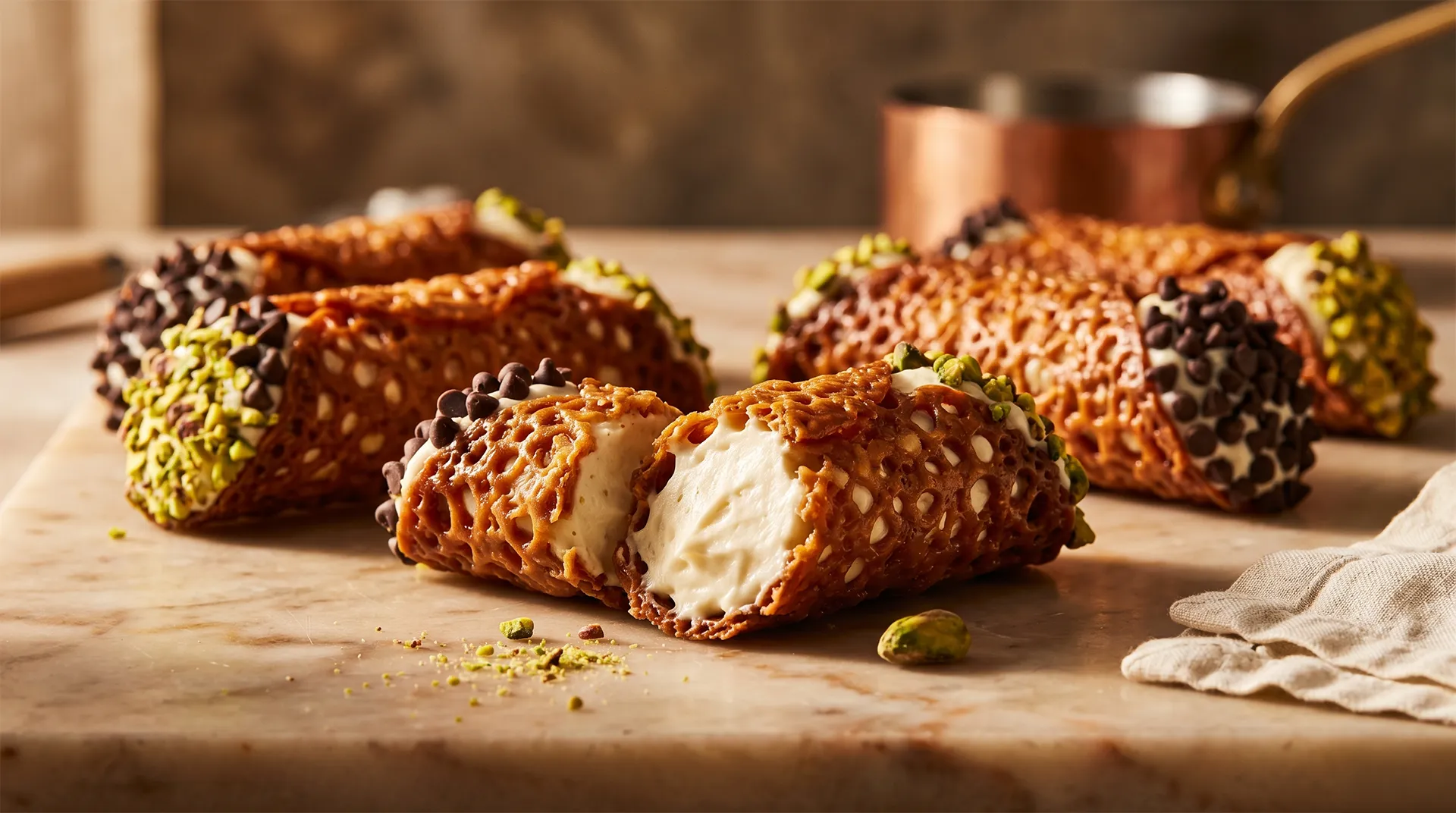
A lace-cookie shell of caramelized beurre noisette and honey, shaped hot into a tube, filled with a mascarpone-stabilized Sicilian ricotta cream.
Yield: 16–18 cannoli | Prep: 30 min | Inactive: 1 hr 30 min | Cook: 30 min | Total: ~2 hr 30 min
Headnote
The conceit here is architectural: replace the traditional fried pastry tube with a Florentine lace cookie bent into shape while it is still hot and pliable. That demands exact timing — from the moment the sheet pan comes out of the oven you have approximately 30 seconds before the caramelized sugar cools through its glass transition and the cookie snaps instead of bends. The filling is classic Sicilian — ricotta, mascarpone, cinnamon, citrus — but drainage is the decisive variable. Ricotta that weeps will destroy the shell within minutes; ricotta that has been drained overnight through cheesecloth will hold the tube crisp for the full service window. Teaching Idea: Sugar Glass Transition. Caramelized sugar exists in two states separated by a thermal threshold (approximately 140–150°F/60–65°C): above it the sugar is amorphous, soft, and plastic; below it the molecules are locked in a rigid glass lattice and the structure is brittle. Hot-shaping exploits the plastic window. The re-warm rescue technique — returning a set cookie to the oven for 15 seconds — works by pushing the sugar back through that threshold, restoring plasticity briefly.
Ingredients
The Florentine Shell
- 57 g (4 tbsp) unsalted butter (weighed before browning)
- 50 g (¼ cup) light brown sugar, packed
- 45 g (3 tbsp) honey
- 30 g (¼ cup) all-purpose flour
- 1 g (¼ tsp) Diamond Crystal kosher salt
- 2.5 ml (½ tsp) pure vanilla extract
The Cannoli Filling
- 450 g (2 cups) whole-milk ricotta, drained overnight
- 60 g (2 oz) mascarpone, room temperature
- 120 g (1 cup) powdered sugar, sifted
- 5 ml (1 tsp) pure vanilla extract
- 1 tsp (approximately 2 g) orange zest (from ½ large orange)
- ½ tsp (approximately 1 g) lemon zest (from ½ lemon)
- 1 g (¼ tsp) ground cinnamon
- 60 g (⅓ cup) mini chocolate chips
For Finishing
- 30 g (2 tbsp) mini chocolate chips
- 30 g (¼ cup) raw pistachios, finely chopped
Mise en Place
- Drain the ricotta: The night before (or minimum 4 hours ahead), line a fine-mesh strainer with two layers of cheesecloth. Add the ricotta, fold the cheesecloth over the top, and set a small weight on top. Refrigerate over a bowl until needed. Discard the whey.
- Temper the mascarpone: Remove from refrigerator 30 minutes before building the filling. Cold mascarpone will break rather than incorporate cleanly.
- Sift the powdered sugar: Sift directly onto a piece of parchment.
- Zest the citrus: Zest the orange and lemon directly over the bowl that will hold the filling, capturing the oils.
- Prepare the baking sheet: Line two baking sheets with silicone mats (preferred) or parchment. On a silicone mat, trace 2-inch circles in pencil as spacing guides if needed — leave at least 3 inches between marks.
- Set up the shaping station: Place a ¾-inch diameter wooden dowel rod or the handle of a wooden spoon (smooth, straight section) on a wire rack beside the oven. Speed is essential — the shaping station must be within arm’s reach before the first sheet goes into the oven.
- Prepare the piping bag: Fit a large piping bag with a large round or large star tip (Ateco 808 or equivalent). Set aside.
- Preheat the oven: 375°F/190°C.
Method
Phase 1 — Brown the Butter
Place the butter in a small, light-colored saucepan over medium heat. Swirl the pan every 30–45 seconds as the butter melts and begins to foam. Watch the bottom of the pan, not the surface: when amber-brown specks appear in the foam and the aroma shifts from sweet cream to toasted hazelnut, pull the pan immediately from the heat.
Pour the beurre noisette into a medium saucepan — transferring it stops the browning instantly. Allow to cool to approximately 115°F/46°C: still liquid, no longer smoking. Do not skip this rest; adding sugar and honey to smoking-hot fat will scorch the honey before it dissolves.
Why: Browning the butter drives off water and toasts the milk solids (Maillard reaction), producing diacetyl and furanones — the compounds behind a toffee-caramel depth that plain melted butter cannot match. This layer amplifies the honey and brown sugar rather than competing with them.
Phase 2 — Build the Shell Batter
Add the light brown sugar and honey to the cooled beurre noisette saucepan. Place over medium heat, stirring with a heatproof spatula, until the sugar dissolves and the mixture is homogenous and just beginning to bubble around the edges — approximately 2–3 minutes. The mixture will look loose and glossy; it will not reach a full rolling boil.
Remove from heat. Add the flour, salt, and vanilla in one addition. Whisk vigorously until the batter is smooth, glossy, and no dry flour remains — approximately 30 seconds.
Transfer to a shallow bowl or small container. Press plastic wrap directly onto the surface. Refrigerate until the batter firms to a scoopable paste — approximately 90 minutes in the refrigerator, or 20 minutes in the freezer.
Sensory Cue: The batter is ready to portion when it holds its shape briefly when scooped — it should not flow back into the bowl immediately. If it is still liquid, return it to the cold for another 10 minutes.
Phase 3 — Bake and Shape the Shells
Work one sheet at a time. Portion the batter using a ¾-teaspoon measuring spoon, rolling each portion into a ball between your palms. Place on the prepared baking sheet with at least 3 inches between portions — these spread aggressively.
Bake at 375°F/190°C for 6–8 minutes. The cookies are done when the edges are deep golden and the centers are amber with a lacy, open bubble pattern across the surface. Pale shells will not develop adequate crunch; dark-brown shells will taste bitter.
The 30-Second Window — Remove and shape immediately:
Slide the pan from the oven and set it on the stovetop or a heat-safe surface. Working quickly, slide a thin offset spatula or bench scraper under the first cookie — it will release cleanly from a silicone mat, with minor resistance from parchment. The cookie is plastic now.
Drape the cookie over the dowel rod with the lacy side facing out. Gently roll your fingers over the top to press the seam closed. Hold for 10–15 seconds until it begins to firm. Slide off the dowel and set on the wire rack seam-side down. Move to the next cookie.
Sensory Cue — Plastic vs. Brittle: A cookie in the plastic window flexes without cracking; you can feel it yield under light finger pressure. A cookie past the window resists bending and will crack audibly with any force. If a cookie sets before you reach it, return it to the oven on the pan for 10–15 seconds — the sugar will re-soften. Do not try to force a brittle cookie; it will shatter.
Shape 3–4 cookies per sheet, then begin the next sheet — do not attempt to shape an entire sheet of 6–8 cookies. The last cookies will be brittle before you reach them.
Allow shaped shells to cool completely on the wire rack. They should be rigid and crisp — any flexibility after cooling indicates underbaking.
Store unfilled shells in a single layer in an airtight container at room temperature for up to 3 days.
Phase 4 — Build the Filling
In a large bowl, combine the drained ricotta and mascarpone. Using a rubber spatula, fold together firmly until fully homogenous — no white streaks, no mascarpone clumps. Do not use a whisk or electric mixer; over-aeration loosens the filling and accelerates weeping.
Add the sifted powdered sugar in two additions, folding gently but thoroughly after each. Add the vanilla, orange zest, lemon zest, and cinnamon. Fold to distribute evenly.
Fold in the mini chocolate chips with 3–4 strokes — chips should be distributed but not crushed.
Sensory Cue: The finished filling should be thick, smooth, and pipeable — it should hold a mound when dropped from the spatula rather than spreading flat. If it looks loose or wet, the ricotta was not adequately drained; refrigerate the filling for 30 minutes and reassess. Thin filling cannot be rescued at this stage.
Transfer to the prepared piping bag. Refrigerate until ready to use (up to 5 days, covered).
Phase 5 — Pipe and Finish
Fill at service — do not fill cannoli ahead of time. The filling will soften the shell within 2 hours; for a plated dessert course, fill no more than 30–45 minutes before service and hold on a chilled sheet pan.
Insert the piping tip into one end of a shell, advancing it halfway through. Pipe with steady, even pressure as you withdraw the tip toward the end, filling that half. Rotate the shell and repeat from the other end. The goal is a continuous column of filling, not two plugs.
Immediately dip both ends in the finishing chocolate chips, then in the chopped pistachios. The pistachio ends are the visual signal of a properly filled cannoli — a single color on both ends means the filling reached the ends cleanly.
Sensory Cue: The shell should still have an audible crunch when bitten through. If the shell bends or yields silently, it has been held too long after filling. That window is your service clock.
Variations
Chocolate Florentine Shell: Replace 5 g (1½ tsp) of the all-purpose flour with 5 g (1½ tsp) Dutch-process cocoa. The cocoa reduces the spread slightly and produces a darker, more brittle shell — reduce bake time by 1 minute and monitor closely. The chocolate-forward shell pairs cleanly with an orange-only filling (omit lemon, double the orange zest, add 1 tsp Grand Marnier to the ricotta).
Dairy-Free Filling: Replace the whole-milk ricotta with a well-drained almond-milk ricotta (Kite Hill or equivalent) and omit the mascarpone. Add 1 tbsp refined coconut oil (unscented) to approximate mascarpone’s fat contribution. The shell itself is naturally dairy-free if a neutral vegetable oil is substituted for the butter — note that beurre noisette flavor is lost entirely; the shell will taste of plain caramel and honey.
Chef’s Notes
The Overnight Drain is Not Optional. Ricotta sold in tubs at most markets contains 60–70% moisture. A 4-hour drain removes some water; overnight removes most of it. The difference is not subtle — inadequately drained ricotta produces a filling that weeps visibly within 20 minutes and destroys the shell’s texture well before the 2-hour window. If pressed for time, drain for a minimum of 4 hours and fold 15 g (1 tbsp) of additional mascarpone into the finished filling as a partial compensating binder.
Shaping Tool: A ¾-inch diameter wooden dowel rod (available at any hardware store, cut to 8–10 inches) is the standardized tool for this recipe. The handle of a wooden spoon works if the diameter matches — measure before committing. Too narrow and the shell collapses; too wide and the filling-to-shell ratio is off. The ¾-inch diameter produces a shell with an internal diameter of approximately 1 cm after the cookie contracts slightly while cooling.
Pistachio Prep: Chop the pistachios by hand — a food processor produces powder, not texture. Aim for pieces roughly the size of a pea. Toast them briefly (5 min at 325°F/163°C) before chopping for deeper flavor.
Make-Ahead Protocol: Shells up to 3 days (airtight, room temperature). Filling up to 5 days (covered, refrigerated). Fill at service only.
Batch Sizing: The shell batter yields 16–18 shells at ¾-tsp portions. The filling yield is generous — it will comfortably fill all 18 shells with filling to spare. Scale the filling to 1.5× if making full batches back-to-back; scale the shell batch fresh each day (baked Florentine shells do not freeze well — sugar glass absorbs ambient humidity and becomes tacky within hours of freezing and thawing).
Glossary
- Beurre noisette: “Hazelnut butter.” Butter cooked until the water evaporates and the milk solids toast to a golden-brown, producing nutty, toffee-caramel aromatic compounds (Maillard reaction).
- Florentine: A flat, lacey confection baked from a caramelized butter, sugar, honey, and flour batter. Characterized by its open bubble structure and brittle, glassy snap when cold.
- Maillard reaction: A non-enzymatic browning reaction between amino acids and reducing sugars that begins above approximately 280°F/138°C, generating hundreds of flavor and color compounds responsible for browned, roasted, and toasted flavors.
- Glass transition: The thermal threshold (approximately 140–150°F/60–65°C for caramelized sugar) below which an amorphous solid becomes rigid and brittle; above it, the material is plastic and workable.
- Mascarpone: An Italian fresh cheese made by curdling cream with acid. Its high fat content (typically 60–75%) functions as an emulsifier and binder in soft fillings, reducing moisture migration and weeping.
- Whey: The water-based liquid fraction of milk or dairy products; expelled from ricotta during draining. Excess whey in a ricotta filling causes it to weep and soften surrounding structures.
- Piping: The technique of forcing a filling through a pastry bag fitted with a tip to achieve a controlled, consistent shape or volume.
- Nappé: The consistency at which a coating or filling is thick enough to hold a mound or coat a surface without flowing — the target consistency for a properly built cannoli filling.